
If your business fell victim to a cyber attack tomorrow, would your systems be back online by lunchtime? With 43% of UK small businesses reporting a security breach in the 2024 Cyber Security Breaches Survey, the risk to firms across London and Hertfordshire is a pressing reality. You likely feel that your current digital setup is a patchwork of expensive software and “good enough” security that keeps you awake at night. It’s frustrating to watch your budget disappear into inefficient tools while you lack the dedicated support of a full-time IT team.
By implementing the best practices for Digit-IT, you can transform your technology from a source of anxiety into a strategic advantage for 2026. We’ll show you how to secure your data, streamline your daily operations, and find peace of mind with a local partner who understands the unique demands of the Home Counties market. This guide provides a clear roadmap to move your business from reactive troubleshooting to proactive growth through expert managed infrastructure and resilient digital strategies.
Key Takeaways
- Learn how to align your digital tools with strategic IT infrastructure to navigate the unique connectivity and security challenges facing London and Hertfordshire SMEs in 2026.
- Master the best practices for Digit-IT by implementing essential cyber hygiene, including multi-factor authentication and robust password vault strategies to harden your defences.
- Protect your business from ransomware by adopting the 3-2-1 backup rule and ensuring your critical data remains immutable and fully recoverable.
- Future-proof your operations by auditing legacy systems and migrating to cloud-first platforms like Microsoft 365 for seamless, agile collaboration.
- Discover why a proactive IT partnership offers a more cost-effective and secure alternative to internal hiring, providing the peace of mind needed to focus on growth.
The 2026 Digital Landscape: Why Best Practices for Digit-IT Matter
Digit-IT represents the strategic fusion of digital tools and IT infrastructure tailored specifically for the modern SME. In the fast-moving commercial hubs of London and Hertfordshire, staying competitive requires more than just functional hardware. It demands a synchronised approach where your software, cloud services, and security protocols work as a single, cohesive unit. Adopting the Best practices for Digit-IT ensures your business doesn’t just survive but leads in an era where digital agility is the primary currency.
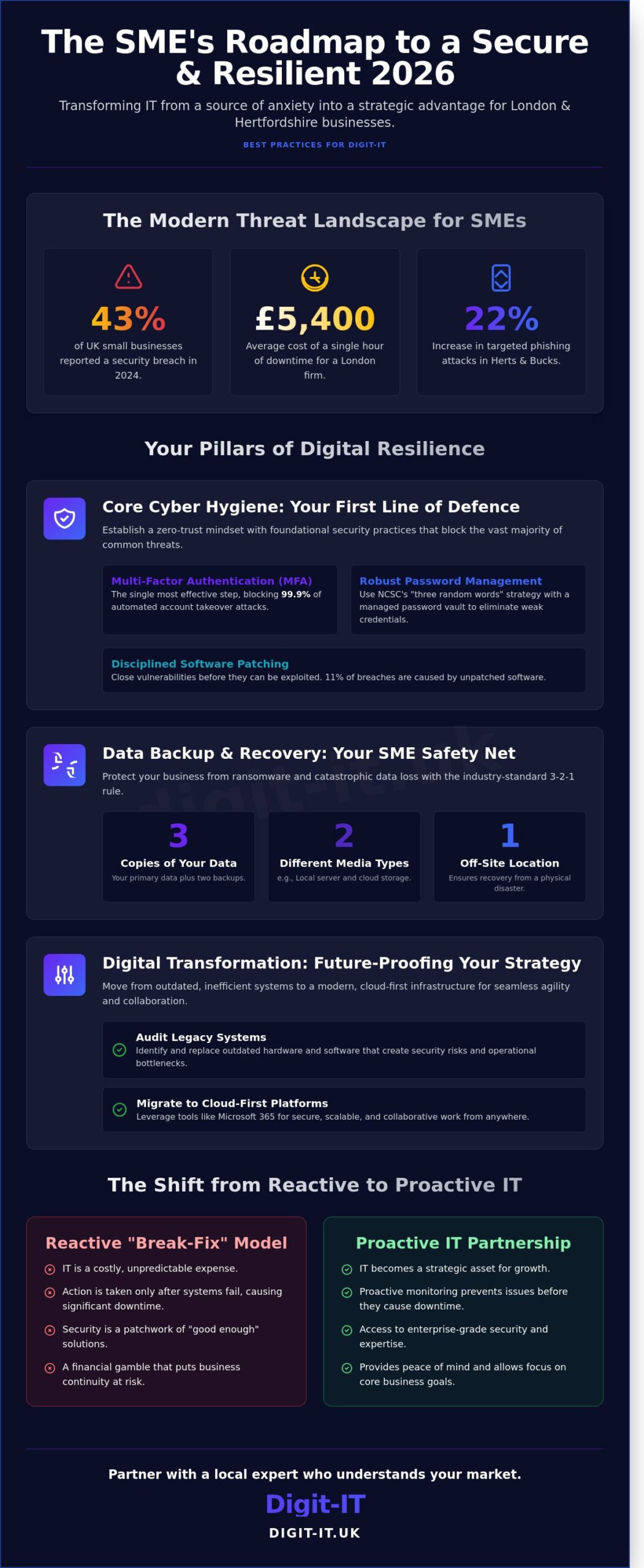
By 2026, the cost of a single hour of downtime for a London-based professional services firm averages £5,400. Relying on a reactive “break-fix” model is no longer a viable strategy; it’s a financial gamble that most small businesses cannot afford. Companies now face the same sophisticated threats as multinationals, requiring a “Trusted Advisor” to navigate the UK’s evolving regulatory environment. This includes staying compliant with the latest iterations of the Data Protection Act and implementing foundational information security best practices to safeguard client trust.
Effective IT management now bridges the gap between human talent and digital capability. When you align your technology with your specific business goals, you remove the friction that slows down growth. This transition from viewing IT as a cost centre to seeing it as a strategic asset is the hallmark of a future-proofed organisation.
The Shift from Maintenance to Resilience
Business continuity is the ultimate metric for success in 2026. While traditional IT focused on keeping systems running, modern resilience focuses on how quickly you recover from the unexpected. Proactive monitoring identifies a failing server drive weeks before it crashes, preventing the catastrophic data loss that shutters 40% of small businesses within two years of a major breach. A resilient framework ensures that high client expectations in the capital are always met, regardless of external technical pressures. You can explore how these resilient systems are built through our specialised IT services.
Local Context: IT in Hertfordshire and Buckinghamshire
Regional business hubs like Watford, St Albans, and High Wycombe have seen a 22% increase in targeted phishing attacks over the last 18 months. Cybercriminals often exploit the perceived “softer” security of firms located outside central London. Having local on-site support is vital for hardware emergencies that remote teams simply cannot solve. A local partner understands regional infrastructure challenges, such as intermittent rural fibre speeds or the specific needs of the Hertfordshire tech corridor. This local expertise helps build a resilient digital community through shared intelligence and rapid, physical response times when every second counts. Following the Best practices for Digit-IT means acknowledging these regional risks and preparing for them with precision.
Core Cyber Hygiene: Protecting Your Business Assets
Establishing a robust security posture isn’t just a technical requirement; it’s a fundamental business strategy for firms across London and Hertfordshire. Best practices for Digit-IT begin with a zero-trust mindset where every access request is verified. Implementing Multi-Factor Authentication (MFA) is your most effective shield. Microsoft research confirms that MFA blocks 99.9% of automated account takeover attacks. For a small business, this single step provides a level of protection that far outweighs its minimal setup cost.
Password management remains a critical vulnerability. We advocate for the “three random words” strategy recommended by the UK National Cyber Security Centre (NCSC). This creates long, complex strings that are easy for humans to remember but nearly impossible for machines to crack. To manage these securely, your team should use managed password vaults. This eliminates the risk of “sticky note” security and ensures that sensitive credentials stay within your controlled environment. We often integrate these tools into our managed IT services to streamline the user experience while maintaining high security.
Software vulnerabilities are a primary entry point for hackers. The 2023 Cyber Security Breaches Survey found that 11% of UK businesses identified a breach caused by unpatched software. You need a disciplined patching cycle that covers Microsoft 365 and all third-party applications. Beyond the code, you must address the human element. 82% of breaches involve social engineering or human error. Regular, bite-sized training sessions help your staff recognise phishing attempts before they click a malicious link.
Advanced Threat Protection for SMEs
Basic antivirus software is no longer sufficient against modern ransomware. You need Managed Detection and Response (MDR) to provide 24/7 monitoring and active threat hunting. This proactive stance is an essential component of a wider data backup and recovery strategy that ensures continuity. We also recommend securing the Cyber Essentials certification. This UK government-backed scheme is often a prerequisite for high-value contracts and demonstrates your commitment to security to your clients.
Secure Wi-Fi and Remote Access
With 40% of the UK workforce now operating in a hybrid capacity, securing the “home office” is vital. Public Wi-Fi is a significant risk; your staff must use corporate-grade VPNs to encrypt data in transit. At the office, segmenting your network ensures that guest Wi-Fi users can’t access your sensitive financial data or client records. This logical separation prevents a minor breach in one area from cascading into a total system failure. If you’re looking to audit your current setup, our team can help you optimise your network infrastructure for both speed and security.
Data Backup and Recovery: The SME Safety Net
Data backup isn’t just a technical task; it’s the insurance policy that keeps your London or Hertfordshire business solvent. Adopting the best practices for Digit-IT starts with the 3-2-1 rule. This strategy requires you to keep three copies of your data, stored on two different types of media, with one copy kept entirely off-site. Relying on a single local drive or a basic cloud sync service leaves your business vulnerable to hardware failure or physical theft. Statistics show that 40% of small businesses never reopen after a major data loss event, making this redundancy vital for survival.
While cloud storage is convenient, it isn’t a complete solution on its own. If ransomware encrypts your local files, those changes often sync instantly to the cloud, corrupting your primary safety net. To prevent this, we deploy immutable backups. These are specialised, write-protected files that cannot be altered or deleted by unauthorised users, even if they gain access to your network. You can explore our data backup and recovery services to see how we implement these layers of protection. For a broader perspective on incident response and risk management, the FTC Cybersecurity Guide for SMEs offers a comprehensive framework for protecting digital assets. Best practices for Digit-IT involve building this level of proactive resilience into every workflow.
Minimising Downtime in a Crisis
Every minute your systems are offline, your revenue stops. We help you define a Recovery Time Objective (RTO), which is the maximum duration your business can survive without its IT systems. For a high-paced London firm, this might be 15 minutes; for a Hertfordshire consultancy, it might be four hours. Through virtualization, we can spin up a digital mirror of your server in minutes, allowing your team to continue working while we repair the primary hardware. We treat these setups like fire drills, conducting quarterly restoration tests to ensure your data is actually recoverable when you need it most.
Compliance and Data Retention
UK GDPR mandates that you don’t keep personal data longer than necessary. This creates a balance between maintaining useful records and managing liability. Holding onto a decade of customer data you no longer use increases your risk profile during a breach. We recommend a strict retention policy: keep what’s legally required, such as financial records for six years, and securely purge the rest. When retiring old hardware, a simple “delete” command is insufficient. We use certified data wiping processes that meet HMG IS5 standards, providing a certificate of destruction to ensure your business remains compliant and your old data stays private.
Digital Transformation: Future-Proofing Your Strategy
Digital transformation isn’t just a buzzword; it’s a structural necessity for firms across London and the Home Counties. Start by auditing your current tech stack to identify “zombie” subscriptions and legacy software. Data from October 2023 indicates that 38% of small business software spend is wasted on redundant or underutilised tools. Eliminating these systems clears the path for a cloud-first infrastructure. Implementing these best practices for Digit-IT ensures your infrastructure supports growth rather than hindering it. We recommend a full audit every 12 months to maintain a lean, agile environment.
A 3-year technology roadmap is vital for strategic planning. It allows you to budget for hardware lifecycles, such as replacing laptops every 36 months. This proactive approach prevents the 15% productivity drop often seen when staff struggle with ageing hardware. Integrating AI tools like Microsoft Copilot can further enhance efficiency. Early adopters report saving 8.5 hours per week by using AI to automate repetitive administrative tasks like meeting summaries and document formatting, allowing your team to focus on high-value client work.
Maximising Microsoft 365 for Business
Using SharePoint and Teams to centralise data reduces internal email volume by up to 40%. It’s about creating a single source of truth for your files. You can learn more about our Microsoft 365 management to see how we secure these environments. Following the best practices for Digit-IT also involves using Microsoft Intune. This tool allows you to manage remote devices across Hertfordshire, ensuring client data stays encrypted even if a laptop is lost in transit.
The VoIP Advantage for Home Counties SMEs
Traditional landlines are being phased out by 2025, making the switch to cloud telephony urgent. A business-grade VoIP solution provides a professional London presence regardless of your physical location. Integrating your phone system with a CRM allows staff to see client details instantly, which typically improves service speed by 25%. Most SMEs see a 40% reduction in monthly communication costs after migrating from legacy ISDN lines. This flexibility is essential for supporting hybrid work models between the city and the suburbs, ensuring your team stays connected whether they’re in a St Albans home office or a Central London boardroom.
The Digit-IT Partnership: Your Dedicated IT Department
Hiring a full-time IT Manager in London currently costs an average of £55,000 per year, excluding National Insurance, pension contributions, and office overheads. For most small businesses in Hertfordshire and the capital, this represents a significant financial commitment for a single point of failure. Outsourcing your technology needs to a specialist provides a more cost-effective alternative, giving you access to a full suite of senior engineers for a predictable monthly fee. This model typically saves SMEs up to 40% on annual technical expenditure while providing 24/7 monitoring that an individual hire simply cannot match.
Our approach centres on proactive maintenance rather than reactive repairs. We use advanced telemetry to identify hardware degradation or security vulnerabilities before they cause downtime. By acting as a seamless extension of your team, we provide strategic consultancy that aligns your digital tools with your commercial objectives. Implementing the best practices for Digit-IT involves moving beyond basic troubleshooting to embrace a managed IT support London strategy that ensures your infrastructure is a catalyst for growth, not a bottleneck.
Bespoke Solutions for Unique Businesses
One-size-fits-all IT packages often leave small businesses paying for redundant features while missing critical security layers. We focus on tailored architecture. For example, we recently assisted a London-based legal firm in scaling from 15 to 45 staff members over 18 months. By implementing a bespoke cloud-first strategy, we reduced their document retrieval times by 30% and ensured total compliance with industry data regulations. Our human-centric approach means you have a direct line to experts who know your business by name, avoiding the frustration of anonymous ticketing systems and scripted responses.
Getting Started with Your IT Health Check
The journey to a more resilient business begins with a comprehensive Digit-IT infrastructure audit. During this process, we evaluate your network stability, software patch levels, and data backup protocols. We look for “quick wins” that can strengthen your security posture immediately. This often includes enforcing Multi-Factor Authentication (MFA) across all platforms, which research shows can prevent 99.9% of account compromise attacks. We also verify that your disaster recovery plan allows for a Return to Operations (RTO) within four hours or less.
Your business deserves technology that works as hard as you do. Best practices for Digit-IT are about creating a foundation for long-term stability and innovation. Contact us to optimise your business IT today and take the first step toward a more secure, efficient, and future-proof digital environment.
Future-Proof Your London Business Today
Adopting a proactive stance toward your digital infrastructure is the most effective way to navigate the complexities of the 2026 landscape. By prioritising core cyber hygiene and establishing a robust recovery safety net, you protect your SME from the rising costs of data loss. Implementing the Best practices for Digit-IT transforms your technology from a potential liability into a resilient engine for growth. It’s about moving beyond reactive fixes to a model of total operational continuity.
Digit-IT brings over 20 years of technical expertise to your doorstep in London and Hertfordshire. We don’t just wait for things to break; our team provides 24/7 proactive system monitoring to ensure your assets remain secure around the clock. We specialise in creating bespoke IT roadmaps that align your digital tools with your specific commercial goals. This partnership ensures you’re always one step ahead of technical shifts and security threats.
Secure your business future with a Digit-IT expert consultation
Your journey toward a more secure and efficient digital future starts with a single strategic decision. Let’s build a foundation that supports your success for years to come.
Frequently Asked Questions
What are the most common IT mistakes small businesses in London make?
Small businesses in London often wait for systems to break before seeking help, a reactive approach that costs 50% more in recovery fees compared to proactive maintenance. Another common error is neglecting Cyber Essentials certification, which leaves vulnerabilities exposed. In 2023, 32% of UK businesses identified a cyber attack. By ignoring these best practices for Digit-IT, companies risk data loss and reputational damage. Proactive monitoring ensures your infrastructure remains resilient and secure.
How much should a small UK business spend on IT support per month?
You should expect to invest between £50 and £150 per user per month for comprehensive managed IT support in the UK. This price range typically covers proactive monitoring, helpdesk access, and essential security layers. Costs vary based on your infrastructure complexity and the level of 24/7 coverage required. Investing 4% to 6% of your annual revenue into technology ensures your business remains competitive and avoids expensive emergency repairs.
Is Microsoft 365 secure enough for my business data without extra protection?
Microsoft 365 provides a robust foundation, but it isn’t fully secure without additional configuration and third-party backups. Microsoft operates on a shared responsibility model, meaning you’re responsible for protecting your own data from accidental deletion or ransomware. Implementing Multi-Factor Authentication (MFA) reduces the risk of account compromise by 99.9%. We recommend adding advanced threat protection to filter the 3.4 billion phishing emails sent daily across the globe.
What is the difference between an IT consultant and a managed service provider?
An IT consultant provides high-level strategic advice for specific projects, whereas a Managed Service Provider (MSP) handles your daily technical operations and long-term maintenance. Think of a consultant as an architect and an MSP as the firm that builds and maintains the house. Most Hertfordshire firms benefit from an MSP approach because it offers predictable monthly costs. This partnership ensures your systems evolve alongside your business goals through continuous optimisation.
How can I protect my Hertfordshire business from local ransomware attacks?
Protecting your Hertfordshire business requires a multi-layered defence strategy, starting with the 3-2-1 backup rule: three copies of data, on two different media, with one copy stored offsite. Ransomware attacks targeted 59% of organisations in 2023, making employee awareness training essential. We implement robust firewalls and endpoint detection to stop threats before they encrypt your files. These best practices for Digit-IT turn your staff into a human firewall against local cyber threats.
What happens if my business IT fails during a bank holiday or weekend?
If your IT fails during a bank holiday, your recovery time depends entirely on the Service Level Agreement (SLA) you have with your provider. Standard 9-to-5 contracts leave you vulnerable for 128 hours every week. We provide proactive monitoring that operates 365 days a year to catch issues before they disrupt your Tuesday morning. Without a weekend support structure, a simple server failure on a Friday evening can result in three days of total downtime.
Does my small business really need a formal disaster recovery plan?
Every small business needs a formal disaster recovery plan because 40% of small firms never reopen following a major data loss event. This document outlines exactly how to restore your operations if a fire, flood, or cyber attack occurs. It defines your Recovery Time Objective (RTO), ensuring you know how many hours it’ll take to get back online. A plan isn’t just a document; it’s a blueprint for your company’s survival and long-term resilience.
How do I know if my current IT provider is following best practices?
You can verify your provider’s standards by checking for formal certifications like Cyber Essentials Plus or ISO 27001. A quality partner will provide monthly reports detailing your system health, patch status, and resolved tickets. If they haven’t discussed a three-year technology roadmap with you, they’re likely being reactive rather than strategic. Transparent communication and regular quarterly business reviews are the hallmarks of a provider committed to your growth and security.
