
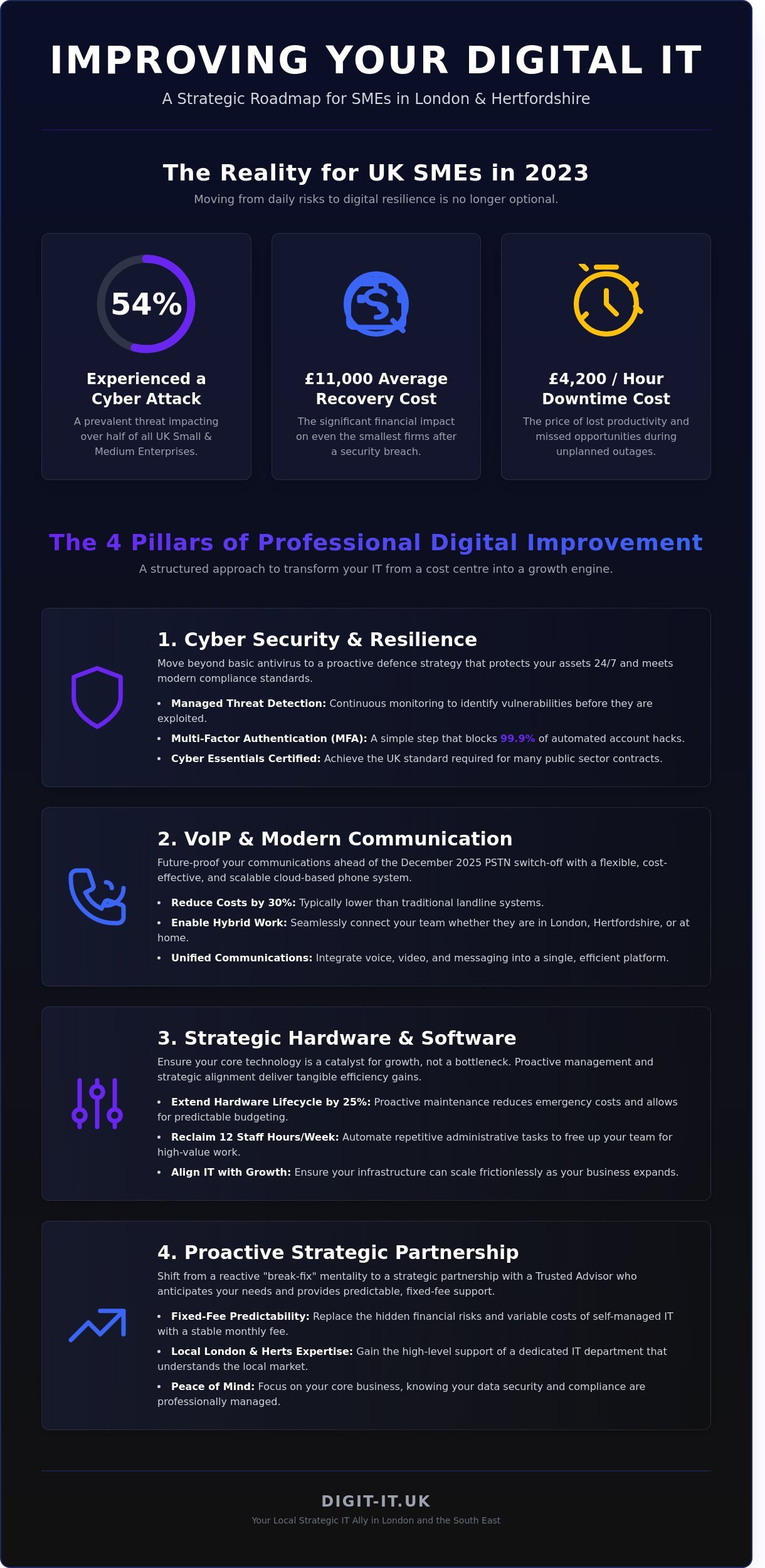
Did you know that 54% of UK SMEs experienced a cyber attack in 2023, with the average cost of recovery reaching £11,000 for even the smallest firms? For business owners in London and Hertfordshire, these aren’t just figures; they’re daily risks that threaten your continuity. You likely feel that your current technology acts as a bottleneck rather than a catalyst for growth. Whether it’s the frustration of sluggish hardware or the confusion over which cloud tools actually add value, you need clarity. This guide explores how to improve Digit-IT by shifting from reactive fixes to a strategic, always-on infrastructure.
We’re here to help you elevate your digital maturity and secure a better ROI from your technology spend. You’ll discover how to build a resilient environment that offers total peace of mind regarding data security and compliance. We’ll walk through the essential steps to modernise your hardware, implement robust local cyber security, and select cloud solutions that truly support your long-term business goals in the South East.
Key Takeaways
- Bridge the gap between basic digital literacy and business-grade maturity by synchronising your hardware, software, and long-term strategy.
- Strengthen your operational resilience by moving beyond basic antivirus to proactive managed threat detection and business-grade communication tools.
- Evaluate the hidden financial risks of self-managed IT compared to the stability and fixed-fee predictability of a professional strategic partner.
- Discover exactly how to improve Digit-IT by following a structured 5-step roadmap designed to identify vulnerabilities and standardise your infrastructure.
- Learn how local expertise in London and Hertfordshire can future-proof your SME, providing the high-level support of a dedicated internal IT department.
What Does it Mean to Improve Digital IT for Your Business?
To understand how to improve Digit-IT, we must first define it accurately. It isn’t merely a collection of faster laptops or a subscription to the latest cloud software. Instead, digital IT represents the strategic synergy between your hardware, software, and overarching business objectives. While basic digital literacy allows a team to operate day-to-day tools, business-grade digital maturity involves creating an environment where technology anticipates your needs.
In 2026, 84% of SMEs across the South East are prioritising digital resilience. This shift is driven by the need to protect operations against sophisticated cyber threats and volatile market changes. Achieving this requires more than a technician; it requires a Trusted Advisor. In the complex London tech landscape, a partner who understands Information technology management acts as a strategic extension of your team, ensuring your systems are an asset rather than a liability.
The Shift from Reactive to Proactive IT
Waiting for a server to fail or a network to crash is the most expensive way to run a business. Industry data indicates that unplanned downtime costs UK SMEs an average of £4,200 per hour in lost productivity and missed opportunities. For firms in Hertfordshire and Buckinghamshire, 24/7 monitoring is no longer a luxury. It’s a fundamental requirement for stability. By identifying vulnerabilities before they cause a system collapse, you can significantly reduce long-term capital expenditure. Proactive maintenance cycles can extend the lifecycle of your hardware by up to 25%, allowing for more predictable budgeting and fewer emergency outlays.
Digital IT as a Growth Catalyst
Technology should serve as a lever for expansion. When you discover how to improve Digit-IT, you unlock the ability to automate repetitive administrative tasks, which can reclaim up to 12 hours of staff time every week. This newfound capacity allows your team to focus on high-value client interactions. The impact of seamless IT on your professional reputation is substantial. Clients notice when your systems are fast, secure, and reliable, which builds a level of trust that competitors with lagging systems cannot match. Digital maturity is the ability to scale without technical friction.
By reviewing our comprehensive managed services, you can begin to align your technical infrastructure with your 2026 growth targets. Moving away from the “break-fix” mentality ensures that your business remains agile, secure, and ready for the challenges of the London and Hertfordshire markets.
The Four Pillars of Professional Digital Improvement
To understand how to improve Digit-IT within your organisation, you must move beyond reactive fixes. A professional digital strategy relies on four distinct pillars that transform IT from a cost centre into a growth engine. By aligning your technology roadmap with your 2026 business goals, you ensure every investment serves a long-term purpose. This proactive stance provides the peace of mind needed to focus on your core operations in London and Hertfordshire, ensuring your infrastructure is an asset rather than a liability.
Cyber Security and Resilience in the UK
SMEs in London are prime targets for cybercriminals because they often lack the sophisticated defences of larger corporations. Phishing and ransomware attacks have become increasingly complex; relying on basic antivirus is a risk you can’t afford to take. Managed threat detection provides a watchful eye over your network 24/7. Achieving Cyber Essentials certification is now a vital step for many firms as it’s often a prerequisite for local government contracts. Implementing Multi-Factor Authentication (MFA) is a foundational step that blocks 99.9% of automated account hacks. You can find additional guidance on protecting your assets in this Cybersecurity for Small Business resource.
VoIP and Modern Communication Tools
The traditional PSTN landline network is reaching its end of life in December 2025. This makes transitioning to a business-grade VoIP system a priority for any modern SME. Cloud-based telephony offers a level of flexibility that legacy systems can’t match, allowing hybrid teams across Greater London to collaborate seamlessly. Switching to a per-seat VoIP model typically reduces communication costs by 30% while providing unified messaging and video conferencing. It’s a scalable solution that grows with your business headcount without the need for expensive hardware installations.
The Microsoft 365 Advantage
Many businesses pay for a subscription but fail to utilise its full potential. Maximising your Microsoft 365 management plan involves more than just using Outlook and Word. You should use SharePoint and Teams to centralise business intelligence securely, ensuring data is accessible to the right people at the right time. A critical detail is backup; Microsoft doesn’t guarantee your data against accidental deletion or breaches. You need independent cloud backups to ensure total resilience and disaster recovery. If you’re looking to audit your current setup, exploring our managed IT services can help identify hidden gaps. This holistic approach is exactly how to improve Digit-IT for long-term stability.
DIY IT vs. Managed IT Support: Which is Right for You?
Many SMEs in Hertfordshire initially delegate technical tasks to the most tech-literate person in the office. It seems like a sensible way to keep overheads low, yet this “DIY” approach creates a fragile single point of failure. If that employee is unwell or leaves the business, your entire digital infrastructure becomes a liability. Relying on a non-specialist leads to reactive spending, where you only address problems after they’ve disrupted your workflow. Emergency call-out fees for unmanaged systems often cost 40% more than planned maintenance. Understanding how to improve Digit-IT within your organisation starts with shifting from this reactive fix-it model to a proactive partnership.
A managed service provider acts as a strategic advisor, ensuring your tools support your goals rather than hindering them. This shift provides a level of security that a single internal employee simply cannot match. It transforms your IT from a source of stress into a seamless utility.
The True Cost of Downtime
Financial impact is the clearest way to measure the value of professional support. For a 10-person firm in London, a four-hour “system down” event is devastating. If the average hourly cost per employee is £30, you lose £1,200 in productivity in one afternoon. This figure ignores the potential loss of new contracts or the damage to your professional reputation. Managed services provide predictable monthly budgeting, allowing you to allocate funds to growth rather than unexpected repairs. You gain peace of mind from knowing experts monitor your network 24/7 to prevent these outages before they occur.
Local Expertise and the South East Business Community
Global call centres often struggle to provide the nuanced support that firms in the South East require. A partner who understands the London and Hertfordshire business landscape offers a distinct advantage. We combine remote efficiency with rapid on-site hardware support when physical intervention is necessary. Our team draws on over 20 years of experience to build long-term relationships based on trust and technical excellence. This local presence ensures that help is always nearby, whether you’re in St Albans, Watford, or central London.
- Proactive Monitoring: We identify and resolve 90% of technical issues before the client even notices a problem.
- Fixed-Fee Clarity: One monthly invoice covers your core IT services, eliminating financial surprises.
- Strategic Alignment: We ensure your technology scales at the same pace as your business ambitions.
Managed IT support isn’t just a line item in your budget; it’s a foundation for resilience. By choosing a local expert, you ensure your team stays focused on their core roles while we handle the digital complexity. This partnership model is the most effective way to learn how to improve Digit-IT and future-proof your operations in a competitive market.
A 5-Step Roadmap to Improving Your Digital IT Infrastructure
Transforming your technology stack requires a methodical approach that moves beyond quick fixes. When business owners ask how to improve Digit-IT, they’re often looking for a way to balance immediate performance gains with long-term resilience. This roadmap provides a structured path to turn IT from a cost centre into a strategic advantage.
Step 1: The Digital Audit
Success starts with a clear picture of your current environment. You must evaluate hardware based on age, performance, and warranty status. Laptops or servers older than 48 months often see a 25% increase in failure rates, costing your business roughly £450 per employee in annual downtime. You also need to identify “Shadow IT,” which refers to applications your team uses without official approval. Recent data suggests 80% of employees use unsanctioned tools to bypass slow internal processes, creating massive data silos and compliance risks. A professional audit is the only way to uncover hidden security gaps.
Step 2: Standardise Your Environment
Complexity is the enemy of efficiency. Running multiple versions of operating systems or a mix of hardware brands makes updates difficult and increases support tickets by up to 30%. By standardising your hardware and software, you simplify the management process. This uniformity allows for rapid, automated patching, ensuring every device in your London or Hertfordshire office remains secure and performant without manual intervention.
Step 3: Building a Security-Conscious Culture
Technology alone cannot protect a business because human behaviour is often the weakest link in your digital IT chain. In fact, 82% of data breaches involve a human element, such as clicking a malicious link. Learning how to improve Digit-IT requires investing in your people as much as your servers. We recommend organising regular 15-minute “toolbox talks” that focus on current phishing trends in the UK, such as fraudulent HMRC notifications or fake Royal Mail delivery alerts. Combine this training with automated password management and multi-factor authentication to create a robust first line of defence.
Step 4: Cloud Migration for Resilience
Migrating critical workflows to the cloud is no longer optional for growing SMEs. Platforms like Microsoft 365 or Azure offer 99.9% uptime and allow your team to work securely from any location. This scalability ensures that if you double your headcount next year, your infrastructure grows with you without the need for expensive on-site server upgrades.
Step 5: Partner with a Managed Service Provider
Maintaining a modern system is a full-time commitment. Partnering with a managed service provider allows you to offload the daily grind of monitoring and maintenance. This partnership provides access to high-level strategic advice, ensuring your technology always aligns with your commercial goals. It moves your business from a reactive “break-fix” model to a proactive state of total coverage.
Ready to modernise your business technology? Explore our comprehensive IT services to start your digital transformation today.
Partnering with Digit-IT: Your Local Strategic IT Ally
Partnering with Digit-IT means gaining a strategic ally that understands the unique pressures of the London and Hertfordshire business corridors. We don’t operate as a distant, faceless vendor; we function as your dedicated, in-house IT department. For many directors, the question of how to improve Digit-IT performance across their remote and office-based teams leads to a realization that technology must follow strategy. Our human-centric approach ensures that every piece of software or hardware we deploy serves a specific business objective. By exploring our comprehensive range of managed IT services, you’re investing in a foundation designed for scalable growth and long-term resilience.
We’ve built our reputation on the concept of future-proofing. This isn’t just a buzzword for us; it’s a commitment to constant innovation. We proactively monitor global tech trends to ensure your SME isn’t left behind by shifting security standards or hardware cycles. Our goal is to alleviate the typical anxieties associated with technical failures, allowing you to focus on your core operations while we maintain the digital engine room. This partnership model bridges the gap between human talent and digital tools, ensuring your technology works for your people, not against them.
Why 20 Years of Experience Matters
Experience provides the foresight to distinguish between passing tech fads and resilient, proven solutions. Since 2004, we’ve guided local firms through every major shift, from the rise of local area networks to the complexities of modern hybrid-cloud environments. Our physical proximity to Greater London and the South East allows us to maintain a 15-minute remote response average, with engineers available for rapid on-site support in St Albans or Central London when critical issues arise. We’ve helped a Hertfordshire-based legal firm professionalise their digital IT, which resulted in a 22% reduction in operational costs and a 35% improvement in file-sharing speeds over a 12-month period.
Your Next Steps to Digital Maturity
Achieving a high-functioning IT environment requires a methodical, calm approach. We’ve refined our onboarding process to ensure a seamless transition that doesn’t disrupt your daily workflow. If you are looking for how to improve Digit-IT systems within your organisation, the process starts with a strategic overview rather than a quick fix. Our advisors look over the horizon to identify risks before they become expensive downtime events.
- Consultation: Book a free initial session with our strategic advisors to map your current digital maturity.
- The First 30 Days: During your first month of Managed IT Support London, we conduct a deep-dive security audit and implement proactive monitoring to stabilise your network.
- Continuous Optimisation: We provide quarterly reviews to ensure your tech stack evolves alongside your business goals.
Ready to improve your digital IT? Contact the Digit-IT team today to secure your business’s future and gain the peace of mind that comes with professional, local IT management.
Future-Proof Your Business with Strategic Digital Resilience
Building a robust digital infrastructure requires moving beyond reactive “break-fix” habits and adopting a long-term strategic mindset. You’ve seen how the four pillars of professional improvement and a structured five-step roadmap can turn technology from a burden into a competitive advantage. Small and medium enterprises across London and Hertfordshire don’t need to navigate these complexities alone. By choosing a managed model over a DIY approach, you gain the stability needed to scale without the constant fear of downtime or security breaches.
Understanding how to improve Digit-IT involves more than just software updates; it’s about securing a dedicated partner. We bring 20+ years of local expertise to your doorstep, providing 24/7 proactive monitoring that identifies threats before they impact your operations. Our strategic partnership model ensures your technology aligns perfectly with your commercial goals, providing a sense of calm authority in an ever-changing digital landscape. It’s time to stop worrying about your server and start focusing on your growth.
Discover how Digit-IT can transform your business today
You’re ready to take the next step toward a seamless digital future, and we’re here to guide you every step of the way.
Frequently Asked Questions
How much does it cost to improve my business IT infrastructure?
Improving your IT infrastructure typically costs between £1,200 and £5,000 for a small office setup, depending on your hardware requirements and cloud migration needs. For ongoing support, London SMEs usually budget between £45 and £150 per user, per month. These figures ensure your systems remain resilient and proactive. Investing in high-quality hardware now prevents the 20% productivity drop often seen with legacy systems over five years old.
What is the most important part of digital IT to fix first?
Cybersecurity and data backup are the most critical elements to address immediately. 60% of small businesses that suffer a major data breach close within six months, so securing your perimeter is vital. We recommend implementing Multi-Factor Authentication (MFA) across all accounts first. This single step blocks 99.9% of automated cyber attacks. Once your data is secure, you can focus on how to improve Digit-IT through better integration and cloud workflows.
Do I need a full-time IT person for a small business in London?
You don’t need a full-time internal IT hire until your headcount exceeds 50 to 80 employees. The average salary for a London-based IT Manager is currently £58,000, which is often double the cost of a comprehensive managed service provider. Outsourcing gives you access to a team of experts for a fraction of the cost. This approach provides 24/7 monitoring that a single employee simply cannot offer.
How can I tell if my business cyber security is actually working?
You can verify your security through regular penetration testing and by achieving the UK government’s Cyber Essentials certification. A working system should provide monthly reports showing 100% of detected threats were neutralised and that your backup recovery time objective is under four hours. If you haven’t tested your restoration process in the last 90 days, your security isn’t truly proven. We provide these metrics to ensure total transparency.
Will improving our IT systems cause downtime for my staff?
Modern IT upgrades shouldn’t cause any noticeable downtime for your team. We perform major migrations and server updates during “quiet hours,” typically between 8:00 PM and 6:00 AM or over weekends. By using cloud-based transitions, we maintain a 99.9% uptime guarantee during the switch. Your staff will simply log in the next morning to a faster, more responsive environment without losing any billable hours.
What are the benefits of using a local IT support company in Hertfordshire?
Local support in Hertfordshire ensures an engineer can be on-site within 2 hours for hardware emergencies that remote tools can’t fix. Being nearby allows us to build a genuine partnership through regular face-to-face strategy meetings in towns like St Albans or Watford. This local presence reduces travel costs and ensures your provider understands the specific connectivity challenges faced by businesses in the Home Counties.
Is Microsoft 365 enough for my business security needs?
Microsoft 365 provides a strong foundation, but the standard “Business Basic” or “Standard” tiers lack advanced threat protection. You need to upgrade to “Business Premium” or add third-party email filtering and independent cloud backups to be fully resilient. 25% of data loss in the cloud is caused by accidental user deletion, which Microsoft’s default settings won’t always recover. We bridge these gaps with bespoke security layers.
How often should a small business upgrade its hardware?
You should replace primary hardware like laptops and servers every 3 to 4 years to maintain peak efficiency. Research shows that PCs older than 4 years are 2.7 times more likely to need repairs, costing an average of £400 in lost productivity per incident. When considering how to improve Digit-IT, a rolling replacement cycle ensures your capital expenditure remains predictable while your team benefits from the latest processing speeds.
