
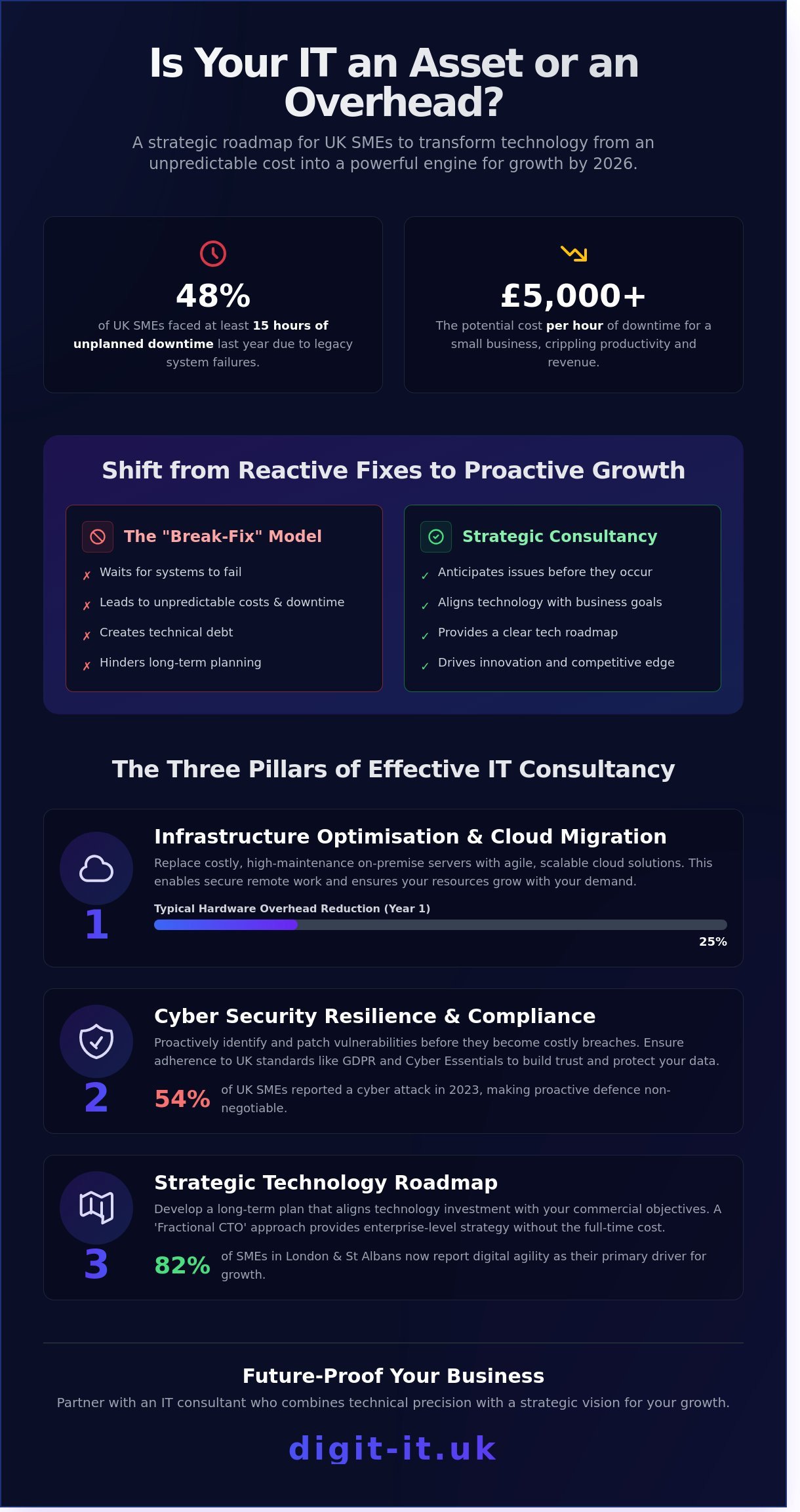
Does your current technology serve your 2026 growth strategy, or is it merely an unpredictable overhead you’ve learned to tolerate? Recent industry reports show that 48% of UK small-to-medium enterprises faced at least 15 hours of unplanned downtime due to legacy system failures in the last twelve months. You likely agree that technology should be a catalyst for expansion, yet the anxiety of falling behind competitors in London, Hertfordshire, or Buckinghamshire remains a genuine concern. Partnering with a strategic it consultant allows you to bridge this gap, replacing technical debt with a proactive framework designed for the specific demands of the 2026 market. We’ll demonstrate how to align your infrastructure with your commercial objectives to secure both growth and operational resilience.
This article provides a clear technology roadmap to eliminate unpredictable costs and ensure your data security meets the latest UK compliance standards. We’ll explore the essential steps to reduce downtime and build a digital foundation that supports your long-term vision with absolute confidence.
Key Takeaways
- Understand how an expert it consultant acts as a strategic partner to shift your operations from reactive ‘break-fix’ cycles to proactive digital growth.
- Explore the three pillars of effective consultancy that transform technical infrastructure into a commercial asset for SMEs in 2026.
- Evaluate the benefits of the ‘fractional CTO’ model versus project-based support to find the most cost-effective and scalable solution for your firm.
- Gain a practical checklist for choosing a local partner in London or Hertfordshire who combines technical precision with deep regional knowledge.
- Discover how a human-centric approach to future-proofing ensures your organisation remains resilient and competitive in an evolving digital landscape.
What is an IT Consultant and Why is Their Role Critical in 2026?
The 2026 business environment demands more than just a functional laptop and a stable Wi-Fi connection. A modern it consultant acts as a strategic architect, aligning your digital infrastructure with your commercial goals. They’ve moved beyond the limited scope of a technician who merely reacts to errors. Instead, they focus on building resilience and driving digital transformation. For SMEs in competitive regions like London and St Albans, this expertise provides the edge needed to outperform larger rivals. To understand the breadth of this role, it helps to look at the formal definition of What is IT Consulting, which encompasses everything from high-level strategy to operational improvements.
Businesses can’t afford the old break-fix mentality. Waiting for a server to fail before calling for help leads to costly downtime that can exceed £5,000 per hour for a small firm. Modern consultancy prioritises proactive growth. It ensures your systems don’t just work; they thrive. By 2026, the role has evolved into a partnership where the consultant anticipates bottlenecks before they impact your bottom line.
The Difference Between IT Support and Strategic Consultancy
Think of IT support as your local mechanic. They’re essential when your car breaks down or needs an oil change. They maintain the status quo. An it consultant is the automotive engineer who designs the vehicle for peak performance and future endurance. While support keeps your lights on, consultancy ensures those lights are powered by the most cost-effective, scalable technology available. Digit-IT bridges this gap by offering a unified approach that combines daily reliability with long-term vision across our full range of services.
Why UK Small Businesses are Prioritising Consultancy Now
By 2026, the complexity of the UK business landscape has surged. AI integration isn’t a luxury anymore; it’s a requirement for staying relevant. Hybrid work models require sophisticated security protocols that protect data across multiple locations. UK regulations, including updated data protection standards, mean compliance is a moving target. Small businesses are shifting their focus to future-proofing. They’re building digital moats against evolving threats. You can find more detail on building this foundation in our Managed IT Support London guide. This strategic shift ensures that a company’s tech stack remains an asset, not a liability, as market conditions change.
This proactive stance is particularly vital in London and St Albans, where 82% of SMEs now report that digital agility is their primary driver for growth. By leveraging expert advice, these organisations can implement enterprise-grade solutions without the enterprise-grade price tag.
The Three Pillars of Effective IT Consultancy for SMEs
Digital transformation is the alignment of technology with business goals. For small and medium enterprises across the Home Counties, this process requires more than just new software; it demands a strategic partnership. An expert it consultant serves as a trusted advisor, moving beyond the traditional break-fix model to provide a foundation for long-term commercial value. By focusing on three core pillars, businesses can achieve the resilience needed to thrive in competitive markets while maintaining total operational continuity.
Pillar 1: Infrastructure Optimisation and Cloud Migration
Legacy on-premise servers often become a financial burden, requiring expensive maintenance and high energy consumption. Migrating to agile cloud environments allows your business to scale resources instantly as demand fluctuates. This transition typically reduces hardware overheads by 25% within the first year. Scalable cloud solutions ensure your team can work securely from any location, whether in a London office or a home setup. You can explore specific Digit-IT services to identify which cloud model suits your current growth trajectory.
Pillar 2: Cyber Security Resilience and Compliance
Cyber security is a non-negotiable standard for UK firms. With 54% of UK SMEs reporting a cyber attack in 2023, the role of a consultant is to identify vulnerabilities before they become expensive data breaches. Adhering to GDPR and achieving Cyber Essentials certification isn’t just about ticking boxes; it’s about protecting your reputation. Firms in the London financial and tech sectors face heightened risks from sophisticated phishing and ransomware. A proactive approach ensures your defences remain robust against these evolving threats, providing peace of mind for your stakeholders.
Pillar 3: Strategic Roadmap and Budgetary Planning
Many businesses fall into the trap of “emergency spending,” where technology is only purchased when something breaks. This reactive cycle is inefficient and costly. A professional it consultant helps you transition to a planned 3-year technology budget. This roadmap ensures you invest in the right hardware and software at the right time. One-size-fits-all tech stacks usually fail small businesses because they include features you’ll never use. A bespoke strategy ensures every pound spent aligns with your operational needs. If you want to future-proof your organisation, it’s time to partner with experts who understand your vision.
Project-Based vs. Managed IT Consultancy: Which Model Fits Your Business?
Choosing the right engagement model determines how effectively your business scales. It’s the difference between calling an it consultant to patch a specific vulnerability and having a strategic lead design a resilient, future-proof infrastructure. Both models offer distinct advantages depending on your current operational maturity and immediate commercial goals. Understanding whether you need a tactical fix or a long-term strategy is the first step toward technical resilience.
When to Choose Project-Based Consultancy
Project-based work suits defined outcomes with a clear start and end point. If your firm is planning an office move in Watford or a specific software rollout in High Wycombe, a fixed-price agreement provides financial certainty. This model is ideal for one-off digital transformation goals, such as migrating to a new cloud server or conducting a comprehensive security audit. According to the UK Government’s Cyber Security Breaches Survey 2024, the average cost of a cyber attack for a medium-sized business is roughly £1,100 per incident. Investing in a targeted project to achieve Cyber Essentials certification can mitigate these risks without requiring a permanent monthly commitment.
The Benefits of a Long-Term Strategic Partnership
A managed consultancy model, often referred to as a ‘fractional CTO’, offers continuous monitoring and proactive optimisation. This approach moves beyond reactive fixes to provide genuine peace of mind. When an it consultant acts as an extension of your team, they help shape a positive internal culture where technology empowers staff rather than frustrating them. Digit-IT has spent 20 years fostering these deep-rooted partnerships, ensuring that technical strategy always aligns with business continuity and long-term scaling.
A common objection from directors is whether a growing business can afford ongoing consultancy. In reality, proactive managed services can reduce total IT spending by up to 30% by eliminating the high costs associated with emergency call-outs and unplanned downtime. You can explore how these models integrate with your operations by reviewing our strategic IT services. To decide which model fits your current trajectory, use this framework based on your growth targets:
- Micro-businesses (1-10 staff): Focus on project-based consultancy for specific setups or security hardening to keep initial overheads low.
- Scaling SMEs (11-50 staff): Benefit most from the fractional CTO model, gaining high-level expertise without the £80,000 plus salary of a full-time executive.
- Established Organisations (50+ staff): Require long-term partnerships to support internal departments and manage complex, multi-site infrastructures.
How to Choose the Right IT Consultant in Hertfordshire and London
Selecting an it consultant isn’t just about technical proficiency; it’s about finding a strategic partner who understands the local business ecosystem. In Hertfordshire and London, where hybrid working is the standard for 72% of firms, physical proximity remains a critical factor. A consultant based in Watford or St Albans can reach a London office within 60 to 90 minutes if a hardware failure threatens your business continuity. This local presence ensures that your support isn’t just a voice on a phone, but a physical extension of your team.
Your search should prioritise consultants who hold UK-specific certifications. Look for the Cyber Essentials Plus badge, as 80% of common cyber attacks are mitigated by these fundamental security controls. Beyond technical badges, evaluate their business acumen. A high-level consultant focuses on your commercial goals rather than pushing specific software packages. They should treat your infrastructure as a tool for growth, ensuring every pound spent on technology delivers a measurable return on investment.
Key Questions to Ask During Your First Consultation
Start by asking about their track record with companies of your specific size. If you’re a 25-person firm, a consultant who only handles enterprise-level 500-seat environments won’t fit your culture. Inquire about their response times for local Herts businesses; a 4-hour on-site guarantee for critical incidents is a baseline for reliability. Finally, ask them to detail their approach to disaster recovery. With 93% of businesses failing within a year of a major data loss event, you need a partner who treats your data with absolute reverence.
Red Flags to Avoid When Hiring
Avoid any firm that leads with a product pitch before understanding your operational pain points. If they suggest a specific cloud migration strategy before hearing your 2024 growth targets, they’re selling, not consulting. Jargon is another warning sign. If an it consultant cannot explain complex infrastructure in plain English, they’ll likely struggle to align with your non-technical stakeholders. Remember that “cheap” services often hide significant technical debt. In our experience, fixing a poorly implemented network costs 3.5 times more than a professional initial setup. You’re investing in resilience, not just a service desk.
Future-Proofing Your Business with Digit-IT’s Strategic Approach
Digit-IT operates on a foundational belief that technology should serve people, not the other way around. We combine high-level technical expertise with a human-centric approach to ensure your team feels supported rather than sidelined. By acting as a “Trusted Advisor” for businesses in Buckinghamshire and the surrounding counties, we move beyond the traditional break-fix model. We become a permanent fixture in your strategic planning, helping you translate ambitious business goals into digital reality.
Our service model is built on three pillars: visibility, security, and scalability. We don’t wait for a server to fail; we monitor your entire stack 24 hours a day, 365 days a year. This proactive stance is why our clients typically report a 40% reduction in unplanned downtime within the first six months of partnership. As your dedicated it consultant, we ensure your infrastructure is an asset that drives profit, not a cost centre that drains resources.
The Digit-IT Difference: Local Expertise, Global Standards
We bring enterprise-grade solutions to the local market, ensuring small and medium-sized enterprises (SMEs) have the same competitive edge as multinational corporations. Whether you’re managing a remote workforce via Microsoft 365 or require a robust VoIP setup to maintain seamless client communication, our team ensures every tool is optimised for peak performance. Resilience is our core brand value. We’ve helped local firms migrate 100% of their data to secure cloud environments, ensuring that even in the face of local hardware failure, the business stays online.
Our suite of services includes:
- Proactive 24/7 network monitoring and automated threat detection.
- Comprehensive Microsoft 365 management and security hardening.
- Seamless VoIP and unified communication deployments for flexible working.
- Managed infrastructure and strategic hardware lifecycle planning.
Ready to Optimise Your Technology Strategy?
It’s time to stop reacting to technical debt and start leading through innovation. Every hour your team spends troubleshooting a slow connection or a software glitch is an hour stolen from your business growth. By hiring a professional it consultant, you gain access to a strategic roadmap that eliminates these bottlenecks before they occur.
Our process begins with a comprehensive audit of your current IT health. We examine your security posture, backup frequency, and hardware efficiency to provide a clear, jargon-free report. You’ll see exactly where your vulnerabilities lie and how we can close those gaps. This isn’t just about fixing what’s broken; it’s about building a foundation that can support your growth for the next five years and beyond.
Take the first step toward a more resilient future. You can explore our full range of solutions on the Digit-IT services page to see how we tailor our expertise to your specific industry needs. When you’re ready to secure your operations and empower your workforce, book your strategic IT consultation today. We’re ready to help you build a business that is truly future-proof.
Future-Proof Your Growth Across London and the Home Counties
Technology shouldn’t be a source of friction; it’s the engine for your business growth. Navigating the digital landscape of 2026 requires more than just reactive fixes. It demands a strategic alignment of your infrastructure with your long-term commercial goals. By choosing between project-led or managed models, you’re not just buying a service; you’re investing in operational resilience. Digit-IT brings over 20 years of experience in the UK IT sector to help you bridge the gap between complex digital tools and human talent.
Our Cyber Essentials certified experts provide 24/7 proactive technical support, ensuring your systems remain secure and efficient around the clock. Partnering with a dedicated it consultant transforms your technology from a cost centre into a competitive advantage. We focus on “future-proofing” your operations so you can lead your market with confidence. It’s time to replace technical anxiety with total peace of mind and clear strategic direction.
Ready to optimise your infrastructure? Book your bespoke IT consultancy audit with Digit-IT today. We’re here to help your business thrive in an increasingly digital world.
Frequently Asked Questions
What does an IT consultant actually do for a small business?
An it consultant acts as a strategic architect for your digital environment, moving beyond simple fixes to create a roadmap for growth. They evaluate your current infrastructure to identify bottlenecks that cost the average UK small business £1,200 per employee in lost productivity annually. By implementing scalable cloud solutions and optimising workflows, they ensure your technology serves as a catalyst for efficiency rather than a source of frustration.
How much does it cost to hire an IT consultant in the UK?
Investment levels vary based on project complexity, but daily rates for a senior it consultant in the UK typically range between £500 and £1,200. Fixed-price projects for specific migrations or audits often start from £2,500. While these figures represent an initial outlay, the proactive nature of expert consultancy typically delivers a 200% return on investment within the first 18 months through reduced downtime and improved operational resilience.
Do I need an IT consultant if I already have an in-house IT person?
You should consider a consultant to complement your internal team when you require specialist knowledge or high-level strategic planning. While your in-house staff manages daily operations, a consultant provides a fresh perspective on long-term future-proofing and complex digital transitions. This partnership model allows your internal team to focus on core tasks while an expert handles intricate projects like infrastructure overhauls or ISO 27001 readiness.
What is the difference between an IT consultant and an MSP?
An IT consultant focuses on high-level strategy and project-based transformations, whereas a Managed Service Provider (MSP) handles the ongoing, day-to-day maintenance of your systems. Consultants are typically brought in to solve specific architectural problems or lead a digital transformation. In contrast, an MSP provides a steady pulse of support, ensuring your always-on infrastructure remains stable through 24/7 monitoring and helpdesk services.
Can an IT consultant help with my business’s cyber security compliance?
Specialist consultants are essential for navigating the complexities of UK regulations like GDPR and the Cyber Essentials scheme. They perform rigorous gap analyses to identify vulnerabilities that led to 32% of UK businesses reporting a cyber attack in 2023. By implementing proactive security frameworks and robust encryption protocols, they help you achieve a level of resilience that protects your reputation and ensures total compliance with legal standards.
How long does a typical IT consultancy project take to complete?
Project timelines depend on the scope of the engagement, but a standard strategic audit usually takes between two and four weeks to complete. Larger implementations, such as a full cloud migration or a complete infrastructure refresh, can span three to six months. We follow a methodical, phased approach to ensure every transition is seamless and causes zero disruption to your daily business operations.
What are the most common IT challenges for businesses in London and Hertfordshire?
Businesses in London and Hertfordshire frequently struggle with integrating legacy hardware with modern hybrid work requirements. High commercial rents in the South East have pushed 65% of local firms to adopt flexible working, which often exposes weaknesses in remote access security and data synchronisation. Our local expertise allows us to resolve these challenges by deploying robust VPNs and cloud-first strategies that ensure your team remains productive from any location.
How do I know if my business is ready for digital transformation?
Your business is ready for a digital shift if your current systems are more than three years old or if manual processes are slowing your growth. If your team spends over 15% of their week on repetitive tasks that could be automated, it’s time to evolve. A successful transformation replaces these inefficiencies with integrated digital tools, allowing you to scale your operations without a proportional increase in overhead costs.

