

Why are businesses in Hertfordshire and London still paying an average salary of £58,000 for a single IT manager, according to recent UK recruitment data, when cyber threats operate 24/7? You likely feel the pressure of rising recruitment costs in the South East and the frustration of slow response times that stall your productivity. It’s a common struggle to balance the need for high-level technical expertise with the reality of a limited budget. Choosing the right outsourced it support isn’t just about cutting costs; it’s about building a foundation of resilience that allows your team to focus on what they do best.
We promise to guide you through the most cost-effective and secure ways to manage your business technology by comparing modern outsourcing models. According to the 2024 UK Government Cyber Security Breaches Survey, 50% of UK businesses identified an attack in the last year, making proactive protection more vital than ever. This comparison guide breaks down how to optimise your IT spend, achieve predictable monthly costs, and maintain 24/7 security monitoring through a strategic partnership. You’ll discover how to transition from reactive fixes to a future-proofed infrastructure that actively supports your commercial growth.
Key Takeaways
- Identify the ideal service model—whether full, co-managed, or ad-hoc—to ensure your technical infrastructure aligns perfectly with your 2026 business growth objectives.
- Discover the true Total Cost of Ownership for internal staffing and how outsourced it support eliminates hidden expenses like pension contributions and recruitment fees in the London market.
- Understand the critical certifications, such as ISO 27001 and Cyber Essentials, required to fortify your digital resilience and maintain a competitive edge.
- Learn how to apply the “Local Test” to guarantee rapid on-site assistance in Hertfordshire and London, shifting your operations from reactive fixes to proactive stability.
- Gain insights into future-proofing your business by transforming your technology into a strategic advantage through a high-level, long-term partnership model.
Why Hertfordshire and London Businesses are Moving to Outsourced IT Support in 2026
The business environment across the Home Counties has fundamentally changed. Companies no longer wait for a server to crash before calling for help. By early 2026, 78% of SMEs in Hertfordshire have transitioned from reactive “break-fix” models to proactive managed services. This evolution stems from the business practice of outsourcing, which allows leaders to focus on growth while technical experts manage the infrastructure. Outsourced IT support now functions as a strategic heartbeat, identifying vulnerabilities before they cause downtime.
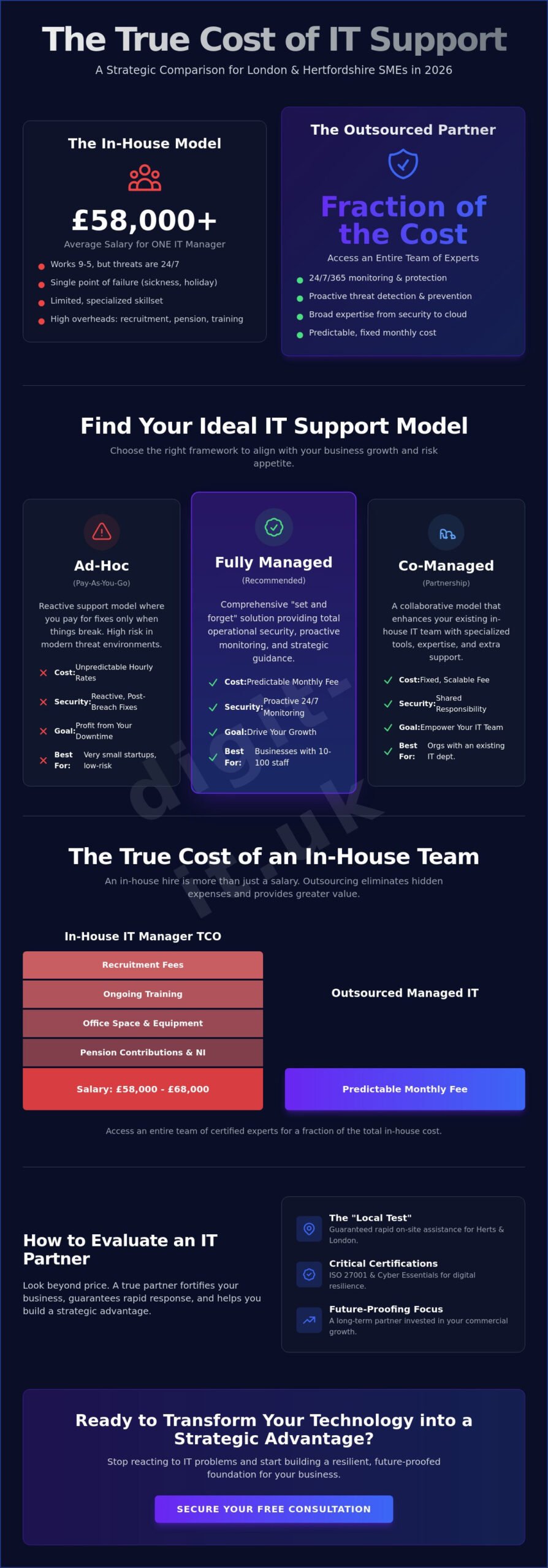
Hiring in-house talent in London is becoming a financial burden for many firms. The average salary for a technical lead in the City reached £68,000 in early 2026. When you add pension contributions, office space, and ongoing training, the cost is often double that of a comprehensive managed service contract. SMEs across Greater London and Buckinghamshire find they can access an entire team of specialists for a fraction of the cost of one full-time employee.
Hybrid work models are now standard. This shift has expanded the attack surface for businesses along the M25 corridor. Securing a network that spans from a central office in St Albans to home setups in rural Buckinghamshire requires sophisticated oversight. Local expertise is vital here. If a hardware failure occurs, having a partner who can reach your site within 60 minutes is the difference between a minor blip and a lost day of productivity.
The Evolving Tech Landscape for London SMEs
London businesses are prioritising cloud-first strategies. Microsoft 365 management has become a full-time requirement rather than a side task. Cyber-attacks targeting UK small businesses rose by 24% in the last year, making robust security a non-negotiable asset. Business owners are choosing outsourced it support primarily for peace of mind. They want to know their data is resilient and their systems are optimised without needing to understand the underlying code.
The Local Advantage: Hertfordshire vs. Global Providers
A provider based in Watford or St Albans offers accountability that a global call centre cannot match. They understand the specific connectivity challenges in rural Buckinghamshire where fibre rollouts might lag. These partnerships are built on shared regional growth. You aren’t just a ticket number; you’re a local partner. This proximity ensures that your IT services are delivered with a personal touch and a deep understanding of the local business landscape.
Comparing IT Support Models: Full vs. Co-Managed vs. Ad-Hoc
Choosing a technical framework is a strategic decision that dictates your firm’s long-term resilience. In the UK, businesses typically navigate three distinct pathways for outsourced it support. The right choice depends on your current headcount, the complexity of your infrastructure, and your appetite for risk. While smaller startups might lean towards reactive help, scaling firms in London and Hertfordshire require a more structured approach to maintain business continuity.
The “Pay-as-You-Go” or Ad-Hoc model is increasingly viewed as a liability in a high-threat environment. Relying on a technician to fix problems only after they occur creates a fundamental conflict of interest; your provider profits from your downtime. With the 2024 Cyber Security Breaches Survey reporting that 50% of UK businesses experienced a breach in the last 12 months, the reactive approach leaves critical gaps in your perimeter that modern hackers easily exploit.
Fully Managed IT: The “Set and Forget” Solution
For businesses with 10 to 100 employees, a fully managed model provides total operational security. This approach delivers comprehensive coverage, from basic helpdesk queries to high-level managed IT support London. You benefit from predictable monthly billing, which stabilises your cash flow and eliminates the shock of emergency repair costs. A standard Service Level Agreement (SLA) ensures that your systems are monitored 24/7, with updates and patches applied before they become vulnerabilities. It is the ideal choice for organisations without an internal IT department that need to focus entirely on their core mission.
Co-Managed IT: Supporting Your Internal Team
Mid-sized London firms are increasingly adopting the co-managed model to bridge the gap between internal knowledge and external expertise. This partnership allows your in-house IT manager to focus on high-level strategy and digital transformation while we handle the repetitive daily tickets and complex cyber security for small business UK. It is a synergy that combines your team’s intimate business knowledge with our deep technical resources. By offloading the “heavy lifting” of server maintenance and security monitoring, your staff gain the headspace to drive innovation. This hybrid structure ensures your outsourced it support acts as an extension of your brand rather than a separate entity.
To determine which model fits your trajectory, you should audit your current ticket volume and the time your leadership spends on technical troubleshooting. If you find that technology is a frequent distraction rather than a tool for growth, it may be time to explore our specialist services to find a more proactive fit.
The True Cost of In-House vs. Outsourced IT for Home Counties SMEs
Many SMEs view technology as a line-item expense rather than a strategic asset. Calculating the Total Cost of Ownership (TCO) reveals a stark contrast between internal hires and outsourced it support. When you hire a single IT Manager, you aren’t just paying a salary; you’re funding an entire department’s worth of infrastructure and risk. If that person is on holiday or falls ill, your digital resilience vanishes instantly. This “single point of failure” is a liability that modern London firms can’t afford to carry.
Scalability presents another financial hurdle. If your business expands by 20 users, a lone IT Manager will likely hit a breaking point. You’re then forced to hire a second technician, effectively doubling your headcount costs overnight. In contrast, a managed service model allows for incremental scaling, ensuring your costs align perfectly with your growth without the sudden shock of a new £50,000+ hire.
The In-House Salary Trap in Greater London
Current 2026 benchmarks for mid-level IT Managers in the London and Hertfordshire region range between £60,000 and £75,000. Once you add 13.8% Employers’ National Insurance, pension contributions, and recruitment fees, the figure often exceeds £95,000. Small businesses also struggle with talent retention; skilled technicians often leave for larger corporations that offer higher training budgets. You’ll also need to purchase your own tech stack, including monitoring tools, security licenses, and ticketing systems, which can add an extra £10,000 to £15,000 to your annual spend.
Outsourcing ROI: Beyond the Monthly Fee
The value of outsourced it support lies in proactive resilience. High-level partners provide 24/7 monitoring that identifies and resolves threats before they cause downtime. For a London firm, even two hours of system failure can result in thousands of pounds in lost billable time. Strategic consultancy also helps reduce operational friction. For instance, integrating the best business VoIP providers in London can significantly lower communication overheads while improving client engagement. This shift transforms IT from a cost centre into a revenue driver by ensuring your team stays connected and productive, regardless of their location.
- Recruitment Savings: Avoid the 15-20% agency fees associated with tech hiring.
- Certifications: Access a team with diverse qualifications without paying for individual exams.
- Security: Benefit from enterprise-grade cyber defence tools included in your service fee.
- Consistency: Ensure 365-day coverage with no gaps for annual leave or sick days.
How to Evaluate an IT Partner in London and Buckinghamshire
Selecting the right provider for outsourced it support isn’t just about technical ability; it’s about finding a partner that aligns with your operational rhythm. In 2026, the gap between a basic break-fix provider and a strategic partner has widened. You need a team that doesn’t just react to tickets but proactively secures your future. Validation begins with certifications. A credible partner must hold Cyber Essentials Plus to demonstrate basic digital hygiene. For businesses handling sensitive data, ISO 27001 remains the gold standard for information security management. Additionally, Microsoft Partner status ensures they’re working with the latest cloud architecture rather than legacy systems.
Don’t overlook the “Local Test.” If your primary internet line fails in St Albans or Watford, can an engineer be on-site within 120 minutes? While remote support handles 95% of issues, that final 5% requires physical presence. When evaluating their helpdesk, look beyond the “first response” time. A 15-minute response is useless if the resolution takes three days. Demand data on their average resolution times for Tier 2 and Tier 3 issues. Transparency is the final pillar. You should receive monthly reports that clearly detail system health, blocked threats, and any emerging security vulnerabilities within your stack.
The Selection Checklist for 2026
Start your search by reviewing it support companies london to ensure their strategic goals match your growth plans. Always ask for testimonials from clients within your specific sector, such as legal or finance, where compliance requirements are unique. A professional transition should follow a documented onboarding roadmap. This prevents the friction phase where 40% of new partnerships typically struggle during the first 90 days. It’s about setting clear expectations from the first hour.
Security and Resilience Standards
Resilience is built on how a provider manages data backup and recovery. Ask for their Recovery Time Objective (RTO) and Recovery Point Objective (RPO) metrics. You should also ask “who guards the guardians?” A provider should be transparent about their own internal security protocols and how they protect their access to your network. True value comes from bespoke IT consultancy that identifies risks before they become expensive failures. This forward-thinking approach ensures your infrastructure evolves alongside your business.
Future-Proofing Your Business with Digit-IT: The Strategic Advantage
Choosing outsourced it support shouldn’t feel like hiring a distant, faceless vendor. Since 2004, Digit-IT has delivered technical resilience to SMEs across Hertfordshire and Greater London, refining a model where we function as a seamless extension of your internal team. We’ve spent 20 years helping local businesses convert their technology from a source of anxiety into a measurable competitive edge. Our approach focuses on long-term stability, ensuring your digital infrastructure is robust enough to handle the challenges of 2026 and beyond.
Effective small business it support must align with your specific commercial objectives. We don’t believe in “break-fix” cycles that leave you vulnerable between repairs. Instead, we look over the horizon to identify potential risks to your business continuity. By integrating proactive maintenance with strategic planning, we help you avoid the hidden costs of downtime, which can exceed £500 per hour for many UK small businesses. Our goal is to provide a sense of calm authority, allowing you to focus on growth while we manage the complexity of your digital environment.
The Digit-IT Partnership Model
Our partnership model is built on bespoke solutions that adapt as your company scales. We provide everything from secure VoIP communication systems to microsoft 365 management, ensuring your team can collaborate safely from any location. We prioritise the human element of technology through proactive account management and regular strategic reviews. These sessions aren’t just technical updates; they’re opportunities to refine your roadmap and optimise your spend. We remain dedicated to providing high-level technical expertise with a local touch for SMEs throughout the Home Counties.
- Proactive Monitoring: We identify and resolve 95% of network issues before they impact your staff.
- Cyber Resilience: We implement Cyber Essentials standards to protect your reputation and client data.
- Strategic Reviews: Quarterly meetings to ensure your IT spend matches your business trajectory.
Next Steps: Securing Your Digital Future
Taking the first step toward better IT doesn’t have to be overwhelming. Our it support for small business london tool is designed to identify critical gaps in your current setup instantly. This data-driven approach allows us to create a tailored recovery and growth plan. Within your first 30 days of partnering with Digit-IT, we conduct a comprehensive audit, harden your security protocols, and onboard your team to our responsive helpdesk. This methodical transition ensures total coverage without disrupting your daily operations.
Don’t leave your digital security to chance. A comprehensive IT health check will reveal whether your current systems can support your 2026 ambitions or if they’re holding you back. We provide the clarity and expertise needed to modernise your workplace with confidence. Contact us for a bespoke IT strategy session and discover how a dedicated partnership can transform your technical infrastructure into a foundation for permanent success.
Secure Your Competitive Edge for 2026
The transition toward outsourced it support represents a fundamental shift in how Hertfordshire and London SMEs maintain their competitive advantage in 2026. By moving away from the high overheads of internal recruitment, your business gains access to a full spectrum of technical expertise. You’ve seen how co-managed models bridge the gap for growing teams, providing the flexibility needed to handle rapid shifts in cybersecurity and cloud infrastructure without the burden of fixed internal costs.
Digit-IT delivers this stability through over 20 years of SME support experience across Herts, London, and Bucks. Our local experts provide 24/7 proactive system monitoring, ensuring your infrastructure is protected against emerging threats while you focus on growth. We act as your strategic partner, bridging the gap between complex digital tools and your long-term commercial objectives. It’s time to stop reacting to technical hurdles and start leveraging technology as a tool for innovation.
Optimise your business technology with Digit-IT; explore our Managed Services
We’re ready to help you build a more secure and efficient digital future.
Frequently Asked Questions
What is the average cost of outsourced IT support for a small business in London?
Most small businesses in London pay between £50 and £150 per user per month for comprehensive outsourced IT support. This price range typically covers proactive monitoring, helpdesk access, and essential security patches. For a 10-person office, you should budget approximately £1,000 monthly to ensure total coverage. These costs vary based on your specific infrastructure complexity and the level of 24/7 support required to maintain business continuity.
How does outsourcing IT support improve our company’s cyber security?
Outsourcing IT support improves your cyber security by deploying enterprise-grade threat detection that 85% of small businesses cannot afford independently. We implement proactive measures like multi-factor authentication and advanced encryption protocols to build digital resilience. Our team monitors your network around the clock to neutralise threats before they disrupt your operations. This approach ensures your business meets Cyber Essentials standards, protecting your reputation and your client data from evolving risks.
Can an outsourced IT provider work alongside our existing in-house technician?
Yes, we frequently operate under a co-managed model to support your existing in-house technician. This partnership allows your internal staff to focus on high-level strategy while we handle the repetitive maintenance and 24/7 monitoring tasks. It provides your team with access to our specialised tools and a broader knowledge base. By acting as an extension of your staff, we ensure your business remains agile and fully supported during holidays or peak periods.
What happens if our server goes down outside of standard UK business hours?
If your server fails outside of standard UK business hours, our 24/7 proactive monitoring system triggers an immediate alert to our on-call engineers. Most critical hardware issues are identified and addressed remotely before your staff starts work the next morning. We maintain a 99.9% uptime target for our clients to ensure your business stays operational. This round-the-clock vigilance eliminates the anxiety of weekend technical failures and protects your bottom line from unexpected downtime.
Will we have to buy all new hardware when we switch to an outsourced provider?
You won’t need to replace all your hardware when switching to an outsourced provider. We conduct a full audit of your current estate to identify which devices are performant and which pose a security risk. If equipment is more than five years old, we’ll suggest a phased upgrade path to optimise your budget. Our goal is to leverage your existing investments while ensuring your infrastructure is robust enough to support modern, high-speed cloud applications.
How quickly can a local Hertfordshire IT support team be on-site?
Our local Hertfordshire team typically arrives on-site within 2 to 4 hours for critical hardware emergencies that cannot be resolved remotely. While 90% of technical tickets are settled via our remote helpdesk, having local engineers in St Albans or Watford ensures rapid physical intervention when needed. This proximity is a vital component of our commitment to business continuity. We prioritise local response times to keep your regional operations running without lengthy disruptions.
What is the difference between managed IT services and outsourced IT support?
The main difference is that managed IT services focus on proactive, long-term strategy while outsourced IT support is a broader term for hiring any external technical help. Managed services involve a flat-monthly fee for total infrastructure oversight and future-proofing your systems. Traditional outsourcing might only cover break-fix scenarios where you pay for help only when things break. We provide a managed partnership that anticipates risks rather than just reacting to them.
Is outsourced IT support suitable for businesses with only 5 to 10 employees?
Outsourced IT support is highly suitable for businesses with 5 to 10 employees because it provides enterprise-level expertise at a fraction of the cost of a full-time hire. Small teams benefit from the same security protocols and cloud optimisations used by much larger corporations. It allows you to scale your technical resources as your company grows without the overhead of internal recruitment. This model ensures your small team remains productive and protected against sophisticated modern cyber threats.
