
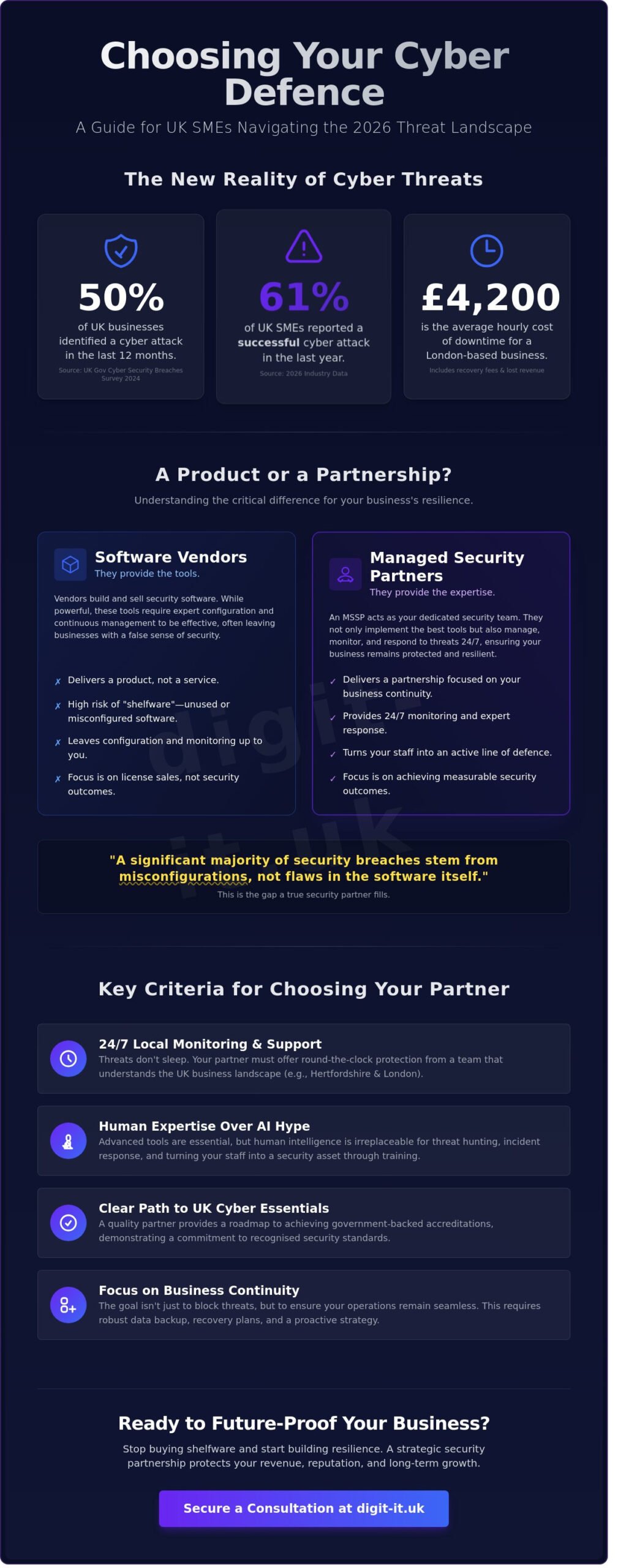
If a ransomware attack encrypted your entire server at 3:00 AM on a Tuesday, would your current IT provider answer the phone, or would you be greeted by an automated voicemail? According to the UK Government Cyber Security Breaches Survey 2024, 50% of UK businesses identified an attack in the last 12 months. As we look toward the sophisticated AI-driven threats of 2026, the gap between basic software tools and dedicated cyber security companies has never been wider. You’re likely exhausted by technical jargon and the constant pressure to purchase “unbreakable” software that doesn’t actually stop human error. It’s frustrating when you can’t tell if you’re buying a shelf product or a genuine service partnership.
We understand that you want more than a digital fortress; you want the peace of mind that comes from knowing your business is resilient and future-proofed. This guide will help you evaluate a local partner who prioritises business continuity over sales targets. You’ll discover a clear roadmap for achieving UK Cyber Essentials compliance and how to secure a local team in Hertfordshire or London that monitors your systems 24/7, ensuring your operations remain seamless regardless of the threat environment.
Key Takeaways
- Understand the 2026 threat landscape and why SMEs in Hertfordshire and London are increasingly targeted by sophisticated AI-driven phishing attacks.
- Learn the critical difference between software vendors and managed partners to ensure you receive proactive protection rather than just digital tools.
- Discover the essential accreditations and local support criteria you must use when evaluating cyber security companies to protect your UK business.
- Identify how a strategic partnership model combines human expertise with 2026 technology to provide a seamless, future-proof defence.
- Gain actionable insights on selecting a partner that aligns with your long-term growth goals while maintaining total operational resilience.
The 2026 Threat Landscape for SMEs in London and Hertfordshire
Small businesses in the Home Counties face a new digital reality. Automated attack scripts now scan the digital perimeter of London firms 24 hours a day. These bots don’t distinguish between a global bank and a local Hertfordshire consultancy; they look for vulnerabilities, not brand names. By 2026, the proliferation of AI-driven scanning means that any business with an internet connection is a visible target. Hackers use generative tools to identify weak points in seconds, making manual security checks obsolete.
Thinking your business is too small to be noticed is a dangerous gamble that rarely pays off. Statistics from early 2026 indicate that 61% of UK SMEs reported at least one successful cyber attack in the previous 12 months. For a London-based business, the real cost of downtime has climbed to approximately £4,200 per hour. This figure accounts for lost billable hours, emergency recovery fees, and the erosion of client trust. Professional cyber security companies focus on building resilience to ensure these costs don’t cripple your operations. Understanding core Cybersecurity principles is the first step toward shifting from a reactive to a proactive posture.
Ransomware Trends Affecting UK Businesses
Modern ransomware has evolved to bypass traditional antivirus software by using “living off the land” techniques. Attackers now use legitimate system tools to encrypt data, staying invisible to basic scanners. To maintain business continuity, your strategy must include off-site, immutable data backup and recovery solutions. Ransomware as a Service (RaaS) is a subscription model that allows amateur criminals to launch professional-grade attacks, significantly increasing the volume of threats facing UK SMEs. This democratisation of cybercrime means local firms must be more vigilant than ever.
The Human Element: Social Engineering in 2026
Technology is only one part of the security puzzle. Hackers frequently use social engineering in security to exploit human psychology. In Buckinghamshire, businesses are reporting a spike in “deepfake” audio calls and highly personalised messages that mimic senior management. Staff awareness training is a critical requirement for modern business hubs. Employees need the skills to spot sophisticated phishing email examples that look identical to internal invoices or HR notifications. Partnering with cyber security companies helps turn your workforce into an active line of defence rather than a point of vulnerability.
The goal is to create a seamless environment where security supports growth. By addressing these threats head-on, you protect your revenue and your reputation in a competitive market. Our approach ensures your managed infrastructure remains robust against the shifting tactics of modern adversaries.
Software Vendors vs. Managed Security Partners: What’s the Difference?
Understanding the distinction between software vendors and managed security service providers (MSSPs) is the first step toward building a resilient infrastructure. Software vendors like Microsoft, CrowdStrike, or SentinelOne are the architects. They build the sophisticated tools designed to detect threats. However, these tools aren’t “set and forget” solutions. Many UK businesses invest heavily in licenses only to find they’ve acquired “shelfware,” which is software that sits idle or remains poorly configured, leaving critical gaps in their perimeter.
Choosing between different cyber security companies often comes down to deciding if you want a product or a partnership. A software vendor provides the shield, but an MSSP is the soldier who knows how to use it. Without expert implementation, unpatched vulnerabilities remain a primary entry point for attackers. Industry data suggests that a significant majority of security breaches stem from misconfigurations rather than flaws in the software itself. This highlights why the “Trusted Advisor” model is gaining traction among firms in Hertfordshire and London; it moves the focus from simply owning tools to achieving measurable security outcomes.
The 2026 global threat landscape report from the World Economic Forum warns that the gap between cyber-resilient organisations and those struggling is widening. For SMEs, bridging this gap requires more than a login for a dashboard. It requires a dedicated team that monitors those dashboards 24/7, ensuring that every alert is triaged and every patch is applied before a vulnerability can be exploited by automated attack vectors.
The Role of a Managed IT Support Partner
A strategic partner integrates security into the fabric of your daily operations. This is where managed IT support London becomes a critical asset. Instead of reactive fixes when things break, a managed partner provides proactive resilience. In 2026, 24/7 monitoring isn’t a luxury; it’s the baseline standard for business continuity. Having a local team that understands your specific infrastructure in London or Hertfordshire ensures that your security posture is tailored to your physical and digital reality.
Leveraging Enterprise Tools for Small Business
MSPs democratise technology by bringing enterprise-grade security to SMEs at a predictable monthly cost. This often involves expert Microsoft 365 management to secure the environment where most work happens. Most cyber security companies will tell you that the cloud is secure, but it’s only secure if your identity management and data policies are correctly enforced. Local businesses need a partner to bridge this technical gap, turning complex software into a seamless business advantage. You can explore our full range of managed security services to see how we protect your growth through strategic alignment.
Key Criteria for Evaluating Cyber Security Companies in 2026
Selecting the right partner from the sea of cyber security companies requires a shift from viewing IT as a utility to seeing it as a strategic asset. By 2026, the sophistication of AI-driven threats means you need a provider that combines high-level accreditation with local accountability. If your server room in St Albans or High Wycombe experiences a physical component failure, a global helpdesk in a different time zone won’t help you. Local presence in Hertfordshire or Buckinghamshire ensures that hardware support and on-site emergency response are hours away, not days.
The most effective cyber security companies prioritize strategic alignment over generic software packages. They should demonstrate a clear understanding of your specific industry regulations and your 2026 growth goals. Transparency is equally vital. You need a partner that provides clear, jargon-free reporting on threats blocked and overall system health. Demand guaranteed Service Level Agreement (SLA) times for critical incidents; a four-hour response window is the benchmark for maintaining business continuity during a breach.
Verification and Compliance Standards
Compliance isn’t a one-time event but a continuous process of improvement. We recommend starting with the UK Government’s Cyber Essentials scheme as your primary filter for any provider. Cyber Essentials is the baseline for UK security because it forces firms to implement five core technical controls that stop 80% of common cyber attacks. Beyond this, look for Cyber Essentials Plus and NCSC assurance to ensure their internal standards match the protection they promise you.
Verification should also include a deep dive into their track record with other local SMEs. Ask for case studies from the last 12 months that prove they can handle quarterly security audits. These audits are now a necessity for 68% of UK mid-market firms to satisfy insurance requirements and supply chain demands. A provider’s ability to navigate these audits successfully is a primary indicator of their technical maturity.
Assessing Technical Depth and Support
A modern defence strategy must look beyond your immediate network perimeter. This includes a proactive approach to dark web monitoring to identify leaked credentials before they’re exploited. Resilience in 2026 relies on Defence in Depth, a multi-layered approach where multiple security controls are layered throughout an IT system. This ensures that if one layer fails, others are ready to stop the intruder.
Technical depth is useless without accessibility. For modern businesses operating outside the traditional 9-to-5, 24/7 helpdesk access is non-negotiable. Our managed cyber security services emphasize this constant vigilance. When evaluating providers, check for:
- Proactive Monitoring: Do they spot threats before you do?
- Multi-Factor Authentication (MFA): Implementation across all legacy and cloud systems.
- Endpoint Detection and Response (EDR): Real-time monitoring of all user devices.
- Rapid Recovery: Proven backup restoration speeds that meet your RTO (Recovery Time Objective).
Reliable security isn’t about buying the most expensive software; it’s about the expertise of the people managing it. Your provider should feel like an extension of your own team, constantly looking over the horizon to protect your future.
Top Categories of Cyber Security Providers for UK SMEs
Selecting the right partner requires a clear understanding of the different tiers within the market. Not all cyber security companies provide the same level of hands-on support. Choosing a provider that doesn’t align with your operational scale often leads to either overpaying for features you won’t use or suffering from a lack of critical support during a crisis.
- Global Software Giants: These firms produce world-class tools like advanced firewalls and AI-driven threat detection. While their technology is elite, their support model is built for enterprises with massive internal IT teams. For a Hertfordshire SME, these giants offer zero personalised guidance and expect your staff to manage the complex configurations themselves.
- Specialist Penetration Testing Firms: These experts are brilliant at finding holes in your defences. They perform deep-dive audits and simulated attacks to test your resilience. However, they are consultants, not operators. They will give you a list of 50 vulnerabilities to fix but won’t be there on a Monday morning to help you patch them or monitor your network. For businesses seeking a more strategic approach, dedicated penetration testing services in Hertfordshire, London, and Buckinghamshire can transform these findings into an actionable, managed defence roadmap.
- National Managed Service Providers: These large UK firms offer scale and broad coverage. The downside is often a “call centre” atmosphere. When you face a technical hurdle, you might wait hours to speak with a rotating cast of junior technicians who don’t understand your specific business workflow.
- Regional Managed IT and Security Partners: This is the strategic sweet spot for SMEs in London and the Home Counties. These partners combine high-end enterprise tools with a boutique service level. They act as an extension of your own team, providing both the strategy and the daily execution required to stay secure.
The Benefits of a Regional Security Partner
Local expertise offers a level of accountability that national firms cannot match. For businesses operating across London and Hertfordshire, a regional partner understands the local threat landscape and can provide rapid on-site assistance when hardware failures occur. This relationship-first approach ensures that your security posture is bespoke, not a “one size fits all” template. You gain a dedicated advisor who proactively monitors your systems, ensuring your infrastructure remains resilient against evolving threats.
Finding the Right Fit for Your Budget
Most modern cyber security companies have moved toward a “Security as a Service” (SECaaS) model. This subscription-based approach allows you to access elite protection for a predictable monthly fee, typically ranging from £40 to £120 per user depending on the complexity of your stack. To avoid hidden costs, ensure your contract explicitly covers patch management and emergency response times. According to the UK Government’s 2023 Cyber Security Breaches Survey, the average cost of a breach for a small business is approximately £4,220. Investing in proactive management is significantly more cost-effective than reactive recovery.
Future-Proofing Your Business with Digit-IT’s Strategic Security
Digit-IT doesn’t just fix problems; we prevent them before they impact your bottom line. As one of the premier cyber security companies serving London, Hertfordshire, and Buckinghamshire, we operate as your high-level strategic partner. We combine two decades of technical heritage with 2026-ready defensive technology to ensure your operations remain resilient against evolving threats. Our approach to cyber security for small business UK is built on total coverage. Whether it’s managing complex firewalls or securing Microsoft 365 environments, we remove the anxiety of technical failure. Business owners need more than a helpdesk; they need a shield that understands the local landscape.
We focus on business continuity as much as technical protection. By aligning our security measures with your specific growth goals, we turn IT from a potential liability into a competitive advantage. Our team monitors the horizon for emerging risks, ensuring that your infrastructure isn’t just protected for today, but is robust enough to handle the digital demands of the next decade. This proactive stance provides genuine peace of mind for leaders who want to focus on their business rather than their server room.
Our Comprehensive Suite of Services
We believe technology only works when the strategy is sound. By integrating advanced security protocols with our core Digit-IT services, we create a seamless environment where protection doesn’t hinder performance. Our 24/7 technical support promise means your systems are monitored every second of the year, providing a rapid response that larger, impersonal cyber security companies often fail to deliver. We act as your dedicated, local IT department, providing the expertise of a full-scale enterprise team without the associated overhead. This local presence across the Home Counties allows us to understand your specific market risks while delivering global-standard resilience and technical precision.
Getting Started: Your 2026 Security Roadmap
The first step toward true resilience is a comprehensive audit of your current IT vulnerabilities. Data from the UK Government’s Cyber Security Breaches Survey showed that 32% of UK businesses identified a breach in a single 12-month period, yet many still rely on outdated 2019-era defences. Now is the time to bridge that gap. We help you build a roadmap that addresses immediate risks like phishing and unpatched software while preparing for the AI-driven threats of the future. Our team evaluates your entire infrastructure to identify weak points before attackers do. Don’t wait for a breach to realise your defences are insufficient. Contact Digit-IT for a professional security consultation today and secure your business’s future with a partner you can trust.
Building Digital Resilience for Your London Business
The 2026 landscape demands more than just basic software. SMEs in London and Hertfordshire need partners who understand that cyber threats evolve daily. Navigating the crowded market of cyber security companies requires a focus on proactive strategy rather than reactive patches. Choosing a partner who bridges the gap between human talent and digital tools ensures your operations remain seamless and secure.
Digit-IT brings over 20 years of technical expertise to your doorstep. We don’t just sell tools; we provide 24/7 proactive system monitoring to identify risks before they disrupt your workflow. Our bespoke solutions are specifically designed for the unique regulatory and operational needs of SMEs across the Home Counties. Industry reports from 2025 indicate that businesses with managed security response times under 15 minutes reduce breach costs significantly. We provide that speed and reliability to protect your bottom line.
Secure your business today with Digit-IT’s expert cyber security services
Your growth depends on a foundation of total coverage and professional stability. Let’s build a secure future for your team today.
Frequently Asked Questions
What is the difference between an IT support company and a cyber security company?
An IT support company focuses on operational efficiency and daily technical issues, while a cyber security company specialises in risk mitigation and data protection. Think of IT support as the engine maintenance and cyber security as the reinforced vault protecting the cargo. Modern cyber security companies provide a proactive layer of defense that goes beyond simple firewall management to include threat hunting and incident response.
How much should a small business in the UK spend on cyber security in 2026?
Small businesses in the UK should aim to allocate between 10% and 15% of their total IT budget to cyber security by 2026. This figure aligns with projections from the Gartner 2024 CIO and Technology Executive Survey, which highlights a shift toward resilience spending. For a firm with a £50,000 IT budget, this means investing £5,000 to £7,500 annually to ensure your infrastructure remains secure against evolving AI-driven threats.
Is Cyber Essentials certification mandatory for all UK businesses?
Cyber Essentials is not legally mandatory for all UK private sector firms, but it’s a requirement for any business bidding on central government contracts involving personal or sensitive data. According to the National Cyber Security Centre (NCSC), 32% of UK businesses identified a breach in 2023. Achieving this certification serves as a baseline for digital resilience and often reduces insurance premiums by demonstrating a commitment to proactive security standards.
Can a cyber security company help if we have already been hacked?
Yes, professional cyber security companies offer incident response services to contain breaches and recover compromised data. We act as your strategic partner during a crisis, following a structured recovery plan to minimise downtime and legal liability. Rapid intervention can reduce the average cost of a data breach, which stood at £3.4 million for UK organisations in 2023 according to IBM’s Cost of a Data Breach Report.
What are the most common cyber threats for businesses in London and Hertfordshire?
Phishing attacks and ransomware remain the most prevalent threats for businesses in London and Hertfordshire. In 2023, the City of London Police reported that 80% of cyber crimes involved some form of social engineering. Local firms often face targeted “spear-phishing” campaigns that exploit the high density of professional services in the region, making proactive employee training and email filtering essential for regional business continuity.
How often should a small business conduct a cyber security audit?
A small business should conduct a comprehensive cyber security audit at least once every 12 months. You should also trigger an ad-hoc audit after significant infrastructure changes, such as migrating to a new cloud platform or opening a secondary office location. Regular testing ensures that your security posture evolves alongside your growth, preventing legacy vulnerabilities from becoming easy entry points for attackers.
Do we need a cyber security company if we use Microsoft 365 or Google Workspace?
You definitely need external security expertise because Microsoft and Google operate under a “Shared Responsibility Model.” While they secure the physical infrastructure, you’re responsible for securing the data, user identities, and third-party integrations within the platform. Expert providers optimise your tenant settings and implement advanced threat protection that the default “out of the box” configurations often lack, ensuring your cloud environment is truly resilient.
What happens if our data is breached despite having a security provider?
If a breach occurs while under a managed service, your provider initiates a pre-defined Disaster Recovery Plan to isolate the threat and restore operations from secure backups. We focus on business continuity to ensure your downtime is measured in minutes rather than days. Having a clear audit trail from your security partner also proves to the Information Commissioner’s Office (ICO) that you took appropriate technical and organisational measures under UK GDPR.

