


If your business passed an automated vulnerability scan yesterday, why could a sophisticated cybercriminal still dismantle your operations tomorrow? Most business leaders in Hertfordshire and London recognize that basic firewalls are no longer a sufficient shield, leading many to seek professional penetration testing services to uncover true weaknesses. You’ve likely felt the increasing pressure from high-value clients to prove your security posture; yet, the distinction between a surface-level scan and a deep-dive assessment remains frustratingly opaque. According to the UK Government’s Cyber Security Breaches Survey 2024, 50% of UK businesses experienced a breach or attack in the last 12 months, proving that reactive measures often fall short.
By investing in a strategic assessment, you transform your digital defense from a guessing game into a proactive business asset. This article outlines how professional testing secures your business continuity, protects your hard-earned reputation, and ensures you meet strict UK data protection standards. We’ll explore the tactical steps required to future-proof your Buckinghamshire or London-based SME against the next generation of cyber risks, providing you with a clear roadmap to total resilience and the peace of mind that your systems are ready for 2026.
Key Takeaways
- Learn why 2026 marks a pivotal shift for UK SME security and how proactive audits ensure your business continuity remains uninterrupted.
- Understand the critical difference between automated vulnerability scans and professional penetration testing services that leverage manual expertise to find hidden logic flaws.
- Master the preparation process for a security audit by defining clear scopes that protect your most sensitive Hertfordshire or London business assets.
- Discover how a bespoke, partnership-led approach to security future-proofs your digital infrastructure against the next generation of cyber threats.
Understanding Penetration Testing Services for Your London Business
Penetration testing is a controlled, ethical strike against your digital infrastructure. It isn’t a passive scan or a simple automated report. Instead, it’s a proactive deep dive where specialists use the same tactics as cybercriminals to uncover hidden weaknesses. For London firms, this means moving beyond theoretical security to practical, battle-tested defense. You’re essentially hiring an expert to break into your systems so you can fix the holes before a malicious actor finds them.
2026 marks a decisive turning point for UK SMEs. With the 2024 Cyber Security Breaches Survey reporting that 50% of UK businesses had identified an attack in the previous 12 months, the margin for error has vanished. Cybersecurity is no longer a back-office technicality; it’s a boardroom priority. Hertfordshire businesses are increasingly ditching “checkbox compliance” in favor of active resilience. They recognize that a certificate on the wall won’t stop a ransomware attack, but rigorous penetration testing services will.
These tests act as the ultimate stress test for your business continuity plan. If a breach occurs, your recovery time objective (RTO) depends on how well you’ve hardened your systems in advance. By simulating a real-world crisis, you ensure your team can maintain operations under pressure. It’s about ensuring that your business remains functional, even when the digital environment becomes hostile.
The Core Objectives of an Ethical Hack
The goal is simple: find the door before the thief does. Our approach focuses on three strategic pillars to ensure your investment delivers maximum value:
- Identifying exploitable vulnerabilities in your network, cloud environments, and applications before malicious actors can exploit them.
- Testing the actual performance of your current IT support and security layers to ensure your defensive tools function as promised during a live incident.
- Evaluating the financial impact of a potential breach, providing your leadership team with a clear, data-driven roadmap for future security investments.
You can explore our full range of strategic IT services to see how these tests integrate with your wider infrastructure and growth plans.
Why SMEs in the Home Counties are Now High-Value Targets
Smaller partners of large London corporations are now the primary entry point for sophisticated supply chain attacks. Hackers often use the “stepping stone” method, targeting a firm in Buckinghamshire to gain credentials that eventually lead them into a Tier 1 bank or law firm in the City. Local business clusters in Watford, St Albans, and Milton Keynes attract attention because they house high-value intellectual property but often lack the enterprise-grade defenses of their larger neighbors.
As your Trusted Advisor, we bridge this gap by providing the high-level security expertise needed to protect regional innovators from global threats while ensuring local compliance stays ahead of UK regulations.
Core Types of Penetration Testing: Securing Your Digital Assets
Effective security isn’t a generic product; it’s a strategic alignment between your technical defences and your specific business risks. In 2026, the perimeter of a Hertfordshire or London business is no longer defined by four walls. It’s a fluid environment of cloud instances, remote endpoints, and interconnected web tools. High-quality penetration testing services must mirror this complexity to provide genuine peace of mind.
We tailor every engagement to your unique infrastructure. A law firm in Buckinghamshire handling sensitive litigation data requires a different testing depth than a London-based e-commerce platform processing thousands of daily transactions. By identifying your most critical assets first, we ensure the testing provides the highest possible return on your security investment.
Network and Infrastructure Testing
Your network is the backbone of your operations. We divide this testing into two distinct phases to ensure total coverage. External testing simulates an attack from the open internet, targeting your digital “front door.” Internal testing, however, is where we often find the most significant vulnerabilities. It assumes a breach has already occurred or an insider threat exists. For a London office, this includes testing lateral movement across the network to see how easily a guest Wi-Fi user could access financial servers.
- Physical and Wireless Security: We assess Wi-Fi encryption and physical access points in Greater London premises. 15% of successful breaches in 2025 originated from poorly secured physical interfaces or legacy wireless protocols.
- Hybrid Workforce Protection: With hybrid working now the standard, we rigorously test VPNs and remote access points. These are frequent targets for credential stuffing attacks.
Web Application and Cloud Security
Web applications are often the weakest link in the digital chain. Our team scans for the OWASP Top 10 vulnerabilities, including broken access control and injection flaws, within your bespoke business tools. As 92% of UK enterprises have now migrated core functions to the cloud, testing your configuration is vital. A simple misconfiguration in an S3 bucket or an Azure tenant can expose millions of records in seconds.
We focus heavily on securing Microsoft 365 environments and AWS/Azure configurations. Many businesses overlook the shared responsibility model, assuming the provider handles all security. In reality, your internal setup is your responsibility. Integrating expert Microsoft 365 management with regular testing ensures your productivity suite remains a fortress rather than a liability. If you’re unsure where your current vulnerabilities lie, exploring our bespoke security services is a proactive first step toward long-term resilience.
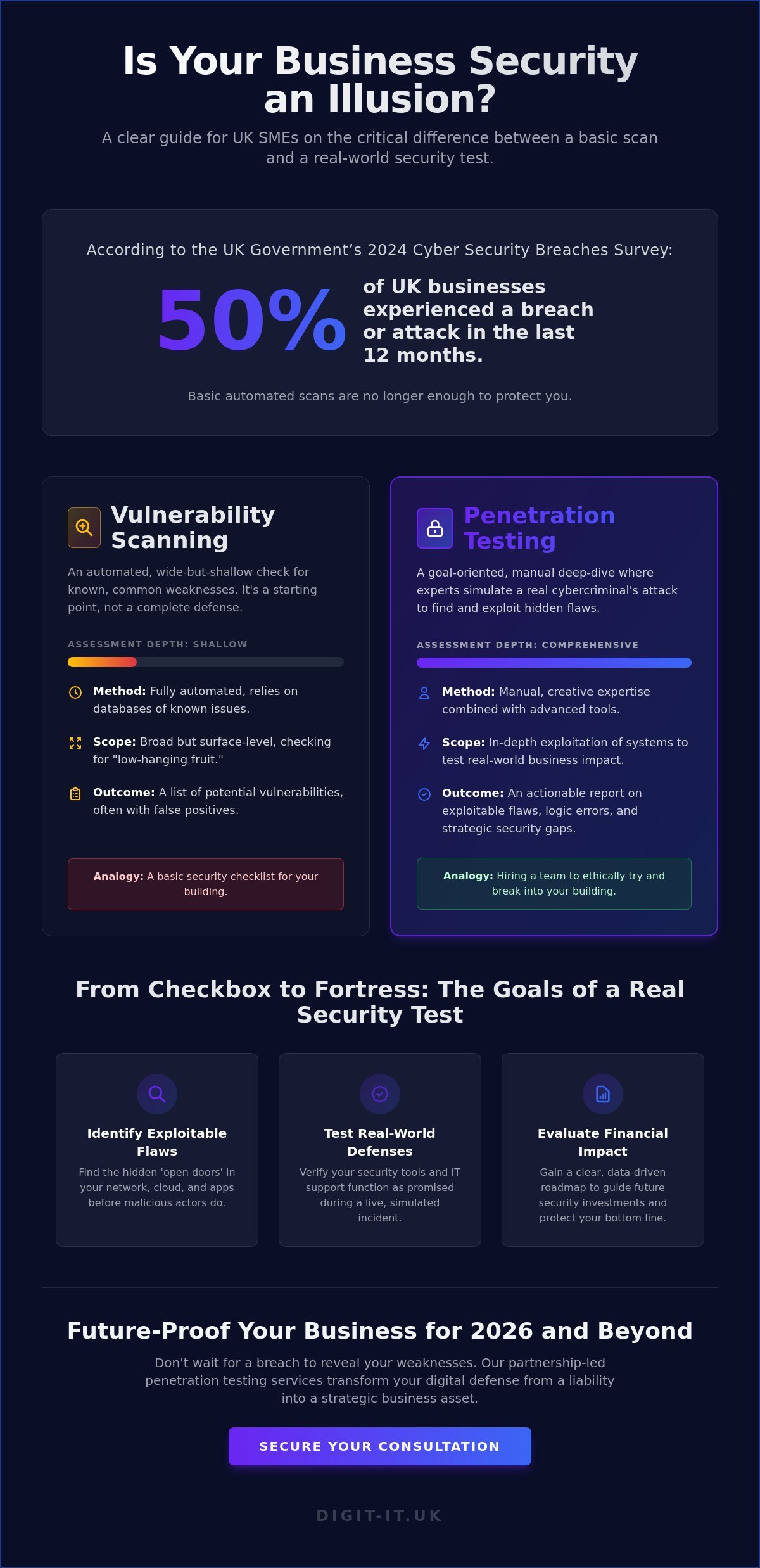
Penetration Testing vs. Vulnerability Scanning: Which Do You Need?
Many SME owners across Buckinghamshire and London mistake automated vulnerability scans for a complete security strategy. While these tools are useful for identifying known software flaws, they lack the critical context required to protect a modern business. A 2024 report from the UK Department for Science, Innovation and Technology (DSIT) revealed that 32% of UK businesses identified a cyber attack in the previous 12 months. For firms in High Wycombe or Milton Keynes, relying solely on automation creates a false sense of security that sophisticated attackers are ready to exploit.
Vulnerability scanning is a broad, high-level check. It’s the digital equivalent of checking if your front door is locked. Professional penetration testing services go much deeper. They involve skilled ethical hackers who actively try to bypass your defences, just as a real criminal would. This proactive approach identifies logic flaws that no automated tool can detect, such as a sequence of legitimate actions that, when combined, allow unauthorised access to sensitive financial data.
The Limitations of Automated Scans
Automated tools often generate significant “noise” in the form of false positives. This forces your internal IT team to waste hours chasing ghosts instead of fixing real threats. A scan cannot understand the specific context of your business operations in St Albans or Watford. It doesn’t know which data is most valuable or which systems are critical for your daily continuity. Algorithms lack the intuition to spot social engineering in security risks, where human error is manipulated to gain system access. Without human oversight, these scans remain surface-level snapshots rather than strategic assessments.
The Value of Manual Ethical Hacking
Manual testing simulates the persistence and creativity of a real-world adversary. Our experts don’t just find a hole; they try to climb through it to see how far they can get. This process often involves “vulnerability chaining,” where three or four minor issues, which a scan might label as “low risk,” are combined to achieve a total system compromise. This depth of analysis is essential for future-proofing your infrastructure against 2026 threat levels. You can explore our full range of strategic IT services to see how we integrate these findings into a broader resilience plan.
For a robust defence, London firms should adopt a hybrid model:
- Monthly Vulnerability Scans: To catch new, known exploits in common software.
- Annual Penetration Testing: To validate your overall security posture and logic.
- Post-Change Testing: Conducted after any major network migration or software deployment.
This combined approach ensures your security budget is spent effectively. You get the efficiency of automation for routine checks and the surgical precision of penetration testing services for your most critical assets. It’s about moving from a reactive “patch-and-pray” mindset to a position of calm, strategic authority over your digital estate.
How to Prepare for a Security Audit in Hertfordshire or London
Effective preparation transforms a security audit from a simple box-ticking exercise into a strategic business asset. When you engage penetration testing services, your goal is to uncover vulnerabilities before a malicious actor does. This requires a collaborative approach between your leadership, your internal teams, and your chosen security partner. Successful audits begin with absolute clarity on what’s being tested and why. You don’t want to waste resources on low-priority systems while critical assets remain exposed.
Communication is the cornerstone of this process. You need to decide if your IT support provider should be aware of the test dates. In 2025, approximately 64% of London firms chose “blind” testing to evaluate their team’s real-time response capabilities. If the goal is a deep-dive technical assessment, providing your testers with documentation and credentials beforehand prevents them from wasting time on basic entry points. This ensures you get the most value for every pound spent on the engagement and allows the testers to focus on sophisticated logic flaws.
Scoping the Engagement
Defining the scope prevents accidental disruptions to your business continuity. You must identify high-value data assets, such as SQL customer databases or proprietary financial records, that require the most scrutiny. Decide whether a “Black Box” approach, where testers have zero prior knowledge, or a “White Box” approach, which involves full architectural transparency, fits your current risk profile. For firms regulated by the FCA or those handling sensitive GDPR-protected data, the scope must align with specific statutory requirements to ensure the final report serves as valid proof of compliance.
Post-Test Remediation and Reporting
The value of a test lies in the actions taken after the final report is delivered. You’ll receive two distinct outputs: a technical log for your developers and a management summary for your board. It’s vital to prioritise fixes based on business risk rather than just technical severity. A “critical” technical flaw in an isolated sandbox environment is often less urgent than a “medium” vulnerability on a public-facing portal. We often work alongside clients through our managed IT support services to implement these fixes efficiently, ensuring your resilience is hardened without stalling your operations.
Secure your infrastructure against emerging threats by speaking with our experts. Consult with our strategic security team today to define your audit scope.
Strategic Security: The Digit-IT Approach to Penetration Testing
At Digit-IT, we don’t view security as a one-off transaction. A single report provides a snapshot in time, but a resilient business requires a continuous roadmap. Based in Hertfordshire, our team brings a local, hands-on touch to technical assessments. Being on-site allows us to identify physical security gaps that remote scanners often miss, such as unsecured server racks or exposed hardware ports in your regional offices. We align your penetration testing services with your broader business objectives, ensuring that every vulnerability we uncover is prioritised based on its actual risk to your 2026 revenue streams.
Our methodology integrates testing results directly into your IT strategy and annual budget. We help you move away from reactive spending. Instead of scrambling to fix issues after a breach, we provide the data needed to allocate resources effectively. This proactive stance ensures that your security spend is an investment in growth rather than a cost of failure. We look over the horizon to identify how emerging threats, such as AI-driven social engineering, might impact your specific industry infrastructure.
A Partnership, Not Just a Service
We function as a seamless extension of your internal team across Greater London and Buckinghamshire. Cybersecurity shouldn’t feel like a series of constant alarms; we maintain a sense of calm authority throughout the testing and remediation process. This collaborative approach is a core part of our cyber security for small business UK framework. We focus on bridging the gap between high-level technical talent and practical business needs, ensuring you have the support to implement changes without disrupting your daily operations.
Next Steps for Your Business Resilience
Resilience is built on consistency. The threat landscape of 2026 moves too fast for annual checks to be sufficient. Data from the UK Government’s Cyber Security Breaches Survey 2024 indicates that 50% of UK businesses experienced a breach or attack in the previous 12 months. This reality demands regular, scheduled penetration testing services to stay ahead of malicious actors. To begin, you can request a bespoke quote tailored to your specific SME requirements by reviewing our managed IT services and security options. Partnering with Digit-IT means you can stop worrying about digital vulnerabilities and focus on your core mission, secure in the knowledge that your peace of mind is our primary objective.
Future-Proof Your Business Resilience
Cybersecurity in 2026 demands a proactive stance that transforms potential vulnerabilities into pillars of strength. You’ve seen how distinguishing between automated scans and deep-dive audits is vital for protecting your digital assets. Proper preparation for a security audit ensures your London or Hertfordshire business remains compliant and operational. Our strategic approach focuses on long-term stability, ensuring your technology supports your growth rather than hindering it.
Digit-IT leverages over 20 years of local IT expertise to provide high-level penetration testing services. We use CREST-aligned methodologies tailored specifically for the unique challenges faced by SMEs in London and the Home Counties. By bridging the gap between human talent and digital tools, we act as a dedicated partner in your success. It’s time to move beyond reactive fixes and embrace a model of total coverage and professional stability.
Secure your business today with a professional penetration test from Digit-IT
We look forward to helping you build a more secure and innovative future for your organisation.
Frequently Asked Questions
How much do penetration testing services cost for a small business in the UK?
Professional penetration testing services for a UK small business typically range between £2,000 and £5,000 per engagement. This investment varies based on the number of IP addresses, web applications, and the depth of the assessment required to secure your data. We provide a transparent breakdown of these costs to ensure your budget is used to optimise your resilience against the latest digital threats.
Will a penetration test cause downtime for my London business?
Your London business won’t experience operational downtime during a professionally managed test. We use controlled methodologies to simulate attacks without disrupting your core business functions or slowing down your network. Our team coordinates closely with your staff to ensure all testing occurs during agreed windows, maintaining your business continuity while we identify potential weaknesses in your infrastructure. This proactive approach ensures your systems remain available.
How often should a Hertfordshire SME conduct a penetration test?
A Hertfordshire SME should conduct a penetration test at least once every 12 months to maintain a strong security posture. The 2024 Cyber Security Breaches Survey found that 50% of UK businesses experienced a breach last year, making regular assessments vital. You should also schedule a test after significant infrastructure changes, such as a cloud migration or a major software deployment, to future-proof your digital environment.
Is penetration testing a requirement for Cyber Essentials Plus?
Technical penetration testing is a mandatory component of the Cyber Essentials Plus certification process. This assessment involves a rigorous audit of your systems to verify that your security controls work effectively against real-world threats. Achieving this standard demonstrates your commitment to proactive security and helps you secure UK government contracts that require this specific level of assurance for data protection and digital integrity.
What is the difference between an internal and external penetration test?
External testing targets your internet-facing systems like websites and email servers to identify perimeter weaknesses that hackers could exploit. Internal testing simulates an attacker who has already breached your perimeter or a malicious insider within your network. Both are essential for a total coverage strategy, as they address different stages of the cyber attack lifecycle and ensure your managed infrastructure is protected from every angle.
Can penetration testing help with my business insurance premiums?
Proactive penetration testing can lead to a 10% to 15% reduction in cyber insurance premiums for many UK companies. Insurers view regular testing as evidence of a mature security posture and a lower risk profile for your organisation. By identifying vulnerabilities before they’re exploited, you demonstrate the resilience that providers look for when calculating your annual coverage costs, making your business a more attractive prospect.
How long does a typical penetration test take to complete?
A typical engagement takes between 3 and 10 working days to complete from the initial scan to the final report. The exact timeline depends on the complexity of your network and the number of physical locations included in the scope. We provide a clear project roadmap from the outset so you can plan your resources and maintain a seamless workflow while our experts conduct their detailed analysis.
What happens if the testers find a critical vulnerability during the test?
We notify you immediately if a critical vulnerability is discovered during the testing process, rather than waiting for the final report. This allows you to take urgent action to mitigate the risk before an actual attacker can find it. Our role as your strategic partner is to provide clear, actionable advice that helps you fix the issue and restore your peace of mind as quickly as possible.

