

The copper-wire era is officially ending; by December 2025, Openreach will permanently disconnect every traditional landline across the UK. This isn’t just a minor update, it’s a total shift in how your business communicates. If you’re feeling pressured by the looming deadline or concerned about the technical hurdles of switching to voip, your caution is justified. Many directors worry that moving to the cloud means sacrificing the reliability they’ve relied on for thirty years.
We’re here to replace that anxiety with a clear, strategic roadmap. You’ll discover how Voice over IP technology actually works and why modern systems offer 99.9% uptime that traditional lines simply can’t match. We’ll show you how to avoid the hidden costs often buried in long-term cloud contracts and ensure your transition happens without a single minute of downtime. From understanding hardware requirements to choosing a partner that acts as an extension of your team, this guide provides the clarity you need to future-proof your London or Hertfordshire business for 2026 and beyond.
Key Takeaways
- Understand the fundamental shift from analogue copper to digital data to ensure your business communication remains resilient and future-proof.
- Navigate the critical implications of the BT/Openreach analogue switch-off to protect your London or Home Counties firm from unnecessary downtime.
- Discover how modern voip technology delivers enterprise-grade reliability and security through strategic Quality of Service (QoS) optimisations.
- Unlock growth potential by leveraging Unified Communications to seamlessly sync your mobile, laptop, and desk phone into one cohesive system.
- Identify why a professionally managed communication strategy outperforms retail “plug-and-play” solutions to provide long-term stability and peace of mind.
Understanding VoIP: More Than Just an Internet Phone
Communication is the backbone of any resilient business. For companies across London and Hertfordshire, the transition to Voice over Internet Protocol (VoIP) represents a fundamental upgrade in how teams connect. While traditional telephony relied on physical copper wires and local exchanges, voip utilizes your existing internet connection to transmit voice data. This shift isn’t just about changing a handset; it’s a strategic move away from the legacy Public Switched Telephone Network (PSTN) that Openreach is currently decommissioning across the UK, with a full national switch-off scheduled by 2027.
The “anywhere office” is no longer a futuristic concept; it’s a daily reality for the 44% of UK workers who now operate in hybrid or remote environments. By abandoning the constraints of analogue lines, businesses gain a level of agility that was previously impossible. You’re no longer tethered to a physical desk in St Albans or a specific floor in a London skyscraper. Instead, your communication infrastructure follows your talent. This ensures business continuity regardless of physical location, turning a potential technical headache into a competitive advantage.
The Core Technology: How Voice Becomes Data
When you speak into a digital handset or a softphone app, your voice is sliced into tiny digital packets. These packets travel across the internet via your router, which acts as the modern exchange, and are reassembled instantly at the other end. This process ensures high-fidelity audio without the crackle associated with old copper lines. Within this ecosystem, SIP Trunking serves as the digital version of a phone line, connecting your on-site equipment to the wider telephone network via the cloud.
VoIP vs. Traditional Landlines: The Key Differences
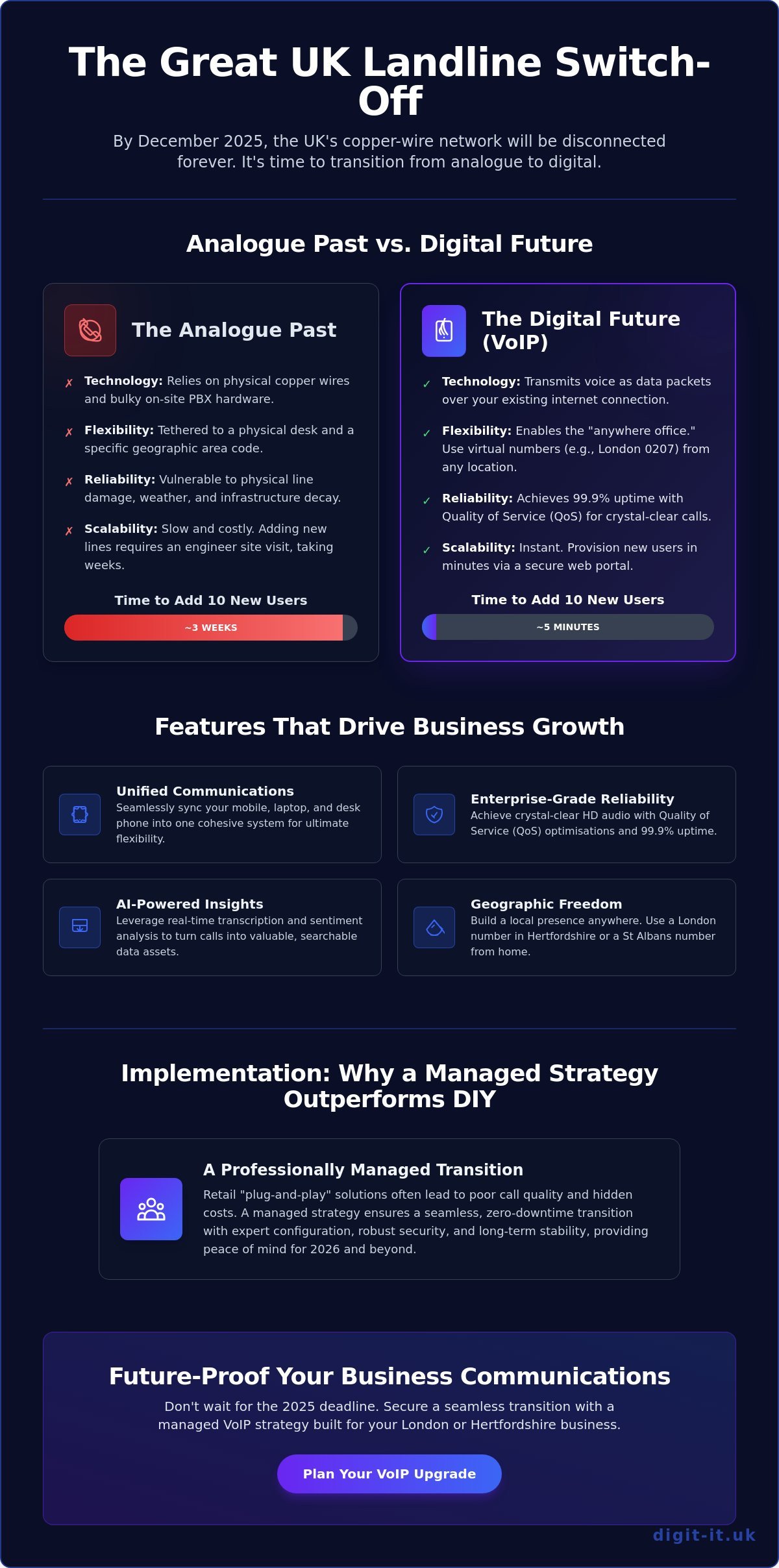
The hardware requirements mark the first major departure from the old ways. Traditional systems required bulky on-site PBX hardware and miles of wiring. Modern setups use sleek IP phones or even existing laptops and smartphones, reducing physical clutter and maintenance costs. Scalability is where the advantage becomes undeniable. In the past, adding ten new lines for a growing team in Watford might take three weeks and a site visit from an engineer. With a managed digital infrastructure, you can provision new users in approximately five minutes through a secure web portal.
Geographic boundaries have also dissolved. Traditional landlines are tied to specific area codes, limiting your local presence. VoIP introduces virtual, nomadic numbers. A business based in Borehamwood can present a London 0207 number to build prestige, or a local 01727 number to foster community trust, all while the team works from home. This flexibility is a cornerstone of modern business resilience, allowing you to scale your presence without increasing your physical footprint.
The Technology Behind the Tone: Reliability and Security in 2026
Many business owners remember the early days of internet calling when dropped packets meant robotic voices and frustrating delays. By 2026, those issues are historical artifacts for companies using professional infrastructure. Modern voip systems deliver audio fidelity that often exceeds the old PSTN standard. This shift is driven by sophisticated “Quality of Service” (QoS) configurations on business-grade routers. QoS acts like a digital VIP lane, ensuring voice packets bypass standard web traffic to prevent latency. According to this FCC guide on VoIP, the technology has evolved to handle critical communications with high reliability and expanded functionality.
In 2026, voip isn’t just about hearing a voice; it’s about capturing intelligence. Integrated AI tools now provide real-time transcription and sentiment analysis. This allows London-based sales teams to identify customer frustration or buying signals instantly, turning a standard phone call into a valuable data asset. Treating voice as a digital record helps firms in Hertfordshire maintain compliance and improve training protocols through searchable call logs.
Ensuring Crystal Clear Call Quality
Professional audio depends on precise bandwidth management to eliminate “jitter,” the irregular arrival of data packets. We use high-definition (HD) voice codecs to capture a broader frequency range, making conversations feel like you’re in the same room. Achieving this level of performance requires a robust foundation. Our managed IT support London ensures your network is fully optimised to handle high-concurrency call volumes without a dip in quality. We focus on proactive monitoring to stop lag before it affects your client relationships.
Security and Resilience for Cloud Voice
Treating voice as data means applying the same rigour you’d apply to your financial records. Criminals increasingly target unsecured systems through “vishing” (voice phishing) or toll fraud, which cost UK businesses over £500 million annually in recent years. We implement end-to-end encryption to shield your conversations from eavesdropping. Robust cyber security for small business UK is no longer optional when your entire communication stack lives in the cloud. We secure your endpoints to prevent unauthorised access and ensure your business remains resilient against emerging threats.
If you’re concerned about your current setup, we can help you optimise your communications infrastructure for better resilience and clarity.
Navigating the Post-PSTN Era in London and the Home Counties
Openreach finalized the national PSTN withdrawal by December 2025. For firms in Watford, St Albans, or Hemel Hempstead, the copper-based network that served the UK for over a century is now a legacy relic. You can’t simply plug a handset into a wall socket and expect a dial tone anymore. This shift forced a move to SoGEA (Single Order Generic Ethernet Access). It’s a broadband connection that delivers data without a traditional phone frequency. If your office still relies on an old PBX system, you’re likely facing connectivity blackouts or high maintenance costs for hardware that no longer has manufacturer support.
One common anxiety involves “mission-critical” devices. Business owners often ask about their lift phones or Redcare alarm systems. These legacy tools were designed for analogue signals. To keep them functional, you’ll need an Analogue Telephone Adapter (ATA) or a transition to mobile-based signalling. Ignoring these peripherals creates a massive compliance risk. Proactive firms are already auditing their physical infrastructure to ensure these safety-critical lines remain active during the migration to voip platforms.
Why the “Big Switch Off” Changed Everything
The transition wasn’t an overnight event but a staggered rollout that began with “stop-sell” orders as early as 2023. By 2026, ISDN lines are technically obsolete. They lack the bandwidth and flexibility required for modern unified communications. For a detailed breakdown on moving away from these legacy systems, see our choosing a business phone service guide for migration tips. Understanding this technology is easier if you consult the Federal Communications Commission (FCC) guide to VoIP, which outlines how voice data travels over digital packets rather than physical circuits.
Virtual Presence: Sounding Local from Anywhere
Modern voip systems eliminate the geographical tether of the physical exchange. You can maintain a prestigious 020 London presence or a local 01923 Watford identity while your team works from home in the Home Counties. This flexibility is vital for the 44% of UK workers who now operate in a hybrid capacity. It allows a small business in Hertfordshire to project the image of a major city-based corporation without the overhead of a Central London lease.
Number porting allows you to bring your established business numbers into the cloud. It’s a seamless process that ensures you don’t lose years of brand equity. Once your numbers are hosted in a virtual environment, you gain features like:
- Automated attendants to route calls efficiently to the right department.
- Time-of-day routing to manage out-of-hours enquiries automatically.
- Simultaneous ringing across mobile and desktop apps to ensure no missed leads.
This proactive approach ensures your business remains resilient and professional. By treating your communication stack as a strategic asset rather than a utility, you turn a technical necessity into a competitive advantage. The goal isn’t just to keep the phones ringing; it’s to build a foundation for future growth.
Core Features That Drive Business Growth and Resilience
Modern voip technology has transformed features that were once high-cost luxuries into standard tools for every business. In 2024, BT reported that 33% of UK businesses had already fully migrated to IP-based systems ahead of the looming PSTN switch-off. For firms in London and Hertfordshire, these features aren’t just conveniences; they’re essential for maintaining a competitive edge. By moving away from traditional copper lines, companies eliminate expensive line rental fees and reduce international call costs by up to 90% in many scenarios.
Traditional ISDN lines often come with fixed monthly costs regardless of usage. In contrast, cloud-based solutions operate on a scalable per-user basis. This flexibility allows a growing firm in Watford to expand its headcount without waiting weeks for physical line installations. By 2025, the total cost of ownership for cloud-based telephony is projected to be 40% lower than legacy hardware systems according to industry benchmarks. This shift moves telecommunications from a capital expenditure to a predictable operational expense.
Unified Communications: One Number, Multiple Devices
The Southeast commuter belt relies on flexibility. Whether your team is at a desk in St Albans or on a train to Euston, they need to stay reachable without sharing personal mobile numbers. VoIP facilitates this through “Follow Me” functionality. This feature rings multiple devices simultaneously, ensuring no client call goes unanswered. It bridges the gap between the office and the home environment seamlessly.
This ecosystem integrates directly with your existing software stack. Achieving true workflow synergy requires expert Microsoft 365 management to sync your contacts, calendars, and call logs across every platform. When your phone system “talks” to your CRM, staff can see exactly who is calling and their previous history before they even pick up the handset. It’s about creating a single, cohesive identity for your business, regardless of where your staff are physically located.
Advanced Call Management for Small Teams
Small firms often struggle with the “one-person-office” sound. Auto-Attendants (IVR) solve this by providing a professional menu system that routes callers efficiently. It makes a three-person team in Hemel Hempstead sound like a global corporation. Hunt groups and call queuing ensure that leads are held in a professional environment rather than hitting a busy signal during peak hours. You can prioritize high-value clients to ensure they’re always at the front of the queue.
Call recording has also become a vital tool for the modern SME. Beyond its use in staff training, it provides the necessary audit trail for regulatory compliance. This is critical for the high number of financial and legal services operating across the London outskirts. Having a secure, searchable database of every conversation provides peace of mind and protects your business against potential disputes. It’s a proactive approach to business continuity that legacy systems simply cannot match.
Implementing VoIP: Why a Managed Strategy Outperforms DIY
Retail providers often market voip as a simple, “plug-and-play” utility. For a London-based firm with high call volumes, this approach is a gamble that rarely pays off. A basic setup lacks the professional oversight needed to ensure quality of service across your entire network. Digit-IT replaces this uncertainty with a managed strategy. Our process begins with a comprehensive audit of your current bandwidth and hardware. We then move to a phased implementation backed by 24/7 monitoring. This proactive stance ensures your communication remains a tool for growth, not a source of technical frustration.
The Risks of DIY VoIP Setup
DIY installations frequently stumble on technical hurdles like poor network configuration or aggressive firewall blocks. These issues don’t just cause minor glitches; they can lead to total communication blackouts. When a business relies on a “cheap” consumer-grade solution, it often fails under the weight of professional pressure. In 2024, industry data indicated that 42% of connectivity issues in small businesses stemmed from misconfigured network hardware. We act as your Trusted Advisor to bypass these traps. By optimising your router settings and prioritising voice packets, we create a stable environment where your calls are always clear. Our team handles the technical heavy lifting, so your staff can focus on their roles without worrying about the tech.
Your Seamless Migration Path
Moving your team to the cloud should be a smooth, stress-free experience. We’ve refined a migration path that guarantees a zero-downtime transition for businesses across Hertfordshire and the capital. This involves pre-configuring your handsets and running parallel systems until we’re 100% confident in the stability of the new line. Investing in managed VoIP and communication service fees provides more than just a dial tone; it offers the peace of mind that comes with expert, UK-based support. This shift represents the crucial first step of your digital transformation. It’s about building a future-proof infrastructure that adapts as your company scales.
London and Hertfordshire businesses operate in some of the most competitive markets in the UK. You can’t afford to let a dropped call stand between you and a new contract. A managed strategy doesn’t just fix today’s problems; it anticipates tomorrow’s needs. By integrating your voip system with your wider IT stack, you create a seamless workflow that empowers your hybrid team. This is the resilience Digit-IT delivers, ensuring your business remains connected, secure, and ready for 2026.
Take the next step in your digital journey. Book your VoIP strategy session with Digit-IT today and ensure your business is ready for the future of work.
Future-Proof Your Business Communications Today
The transition to digital telephony is no longer a distant deadline. With the PSTN switch-off complete, businesses in London and the Home Counties must prioritize a voip strategy that emphasizes both security and scalability. A managed approach ensures your infrastructure isn’t just functional but optimized for the demands of a 2026 marketplace. This shift moves your communication from a simple utility to a strategic asset that drives efficiency and protects your bottom line.
Digit-IT provides over 20 years of local IT expertise, offering more than just a helpdesk. We serve as a dedicated partner, delivering 24/7 proactive monitoring and a UK-based support team that understands the specific challenges of the Hertfordshire business landscape. Our focus on business continuity means we identify risks before they impact your workflow, providing the peace of mind you need to focus on expansion. You’ll benefit from a seamless integration that bridges the gap between sophisticated digital tools and your internal team’s talent.
Upgrade your business communication with our London VoIP solutions
We’re ready to help you navigate these technological shifts and ensure your organization stays connected, resilient, and ahead of the competition.
Frequently Asked Questions
Is VoIP reliable enough for a professional business in 2026?
VoIP is the industry standard for reliability since the UK completed the PSTN switch-off in 2025. Modern managed systems now offer 99.999% uptime, which equates to less than six minutes of downtime per year. By leveraging a high-speed fibre connection, your business achieves crystal-clear voice quality that surpasses traditional copper lines. We ensure your infrastructure is resilient enough to handle peak call volumes without latency or jitter.
Do I need to buy new desk phones to use VoIP?
You don’t always need to invest in new hardware to transition to a voip system. Existing analogue handsets can often be integrated using Analog Telephone Adapters, though most London firms now prefer softphones on laptops or mobile apps. This approach reduces capital expenditure by up to 40% while providing your team with the flexibility to work from any location. We help you audit your current kit to determine the most cost-effective path forward.
Can I keep my existing London or Hertfordshire business phone number?
You can absolutely retain your current 020 or 01707 numbers through a process called number porting. Ofcom regulations ensure that UK businesses can move their existing identities to new providers to maintain brand continuity. We manage the entire porting sequence to prevent any service gaps. This ensures your clients in Hertfordshire and London never experience a “number not in use” message during your digital migration.
What happens to my VoIP phone system if the internet goes down?
Your calls automatically reroute to mobile devices or secondary locations if your primary internet connection fails. We implement proactive failover strategies that trigger within seconds of a detected outage. Because the brain of your system lives in the cloud, not in your physical office, your local numbers remain active. This architecture ensures your business stays reachable even if your local London office faces a temporary power cut.
How much does a business VoIP system typically cost in the UK?
Business subscriptions in the UK typically range from £10 to £25 per user per month according to 2024 industry benchmarks. These costs usually include unlimited UK landline and mobile calls, which can reduce monthly bills by 30% to 50% compared to legacy ISDN lines. While we don’t set fixed prices without a consultation, these market averages provide a reliable baseline for your digital transformation budget and long-term financial planning.
Does VoIP work with Microsoft Teams and other office software?
Modern solutions integrate seamlessly with Microsoft Teams, Salesforce, and HubSpot through Direct Routing or dedicated APIs. This connectivity allows your team to make calls directly from their CRM, saving an average of 15 seconds per dialled number. By synchronising your communication tools, you eliminate silos and create a unified digital workspace. It’s a strategic way to optimise your existing software investments while improving data accuracy across the entire firm.
Is VoIP secure against hackers and eavesdropping?
VoIP is highly secure when implemented with end-to-end encryption protocols like SRTP and TLS. These standards prevent eavesdropping by scrambling voice data as it travels across the network. We align your communication strategy with Cyber Essentials guidelines to protect against the 39% of UK businesses that reported a cyber attack in 2023. Proactive monitoring and robust firewall configurations ensure your private conversations remain confidential and secure at all times.
What is the difference between VoIP and a hosted PBX?
VoIP is the underlying technology that transmits voice over the internet, while a hosted PBX is the virtual switchboard that manages your call routing. Think of voip as the engine and the hosted PBX as the entire vehicle, including the steering and navigation features. A hosted system removes the need for bulky on-site hardware, as the service provider maintains the servers in a secure data centre. This model provides the scalability London businesses need.

