


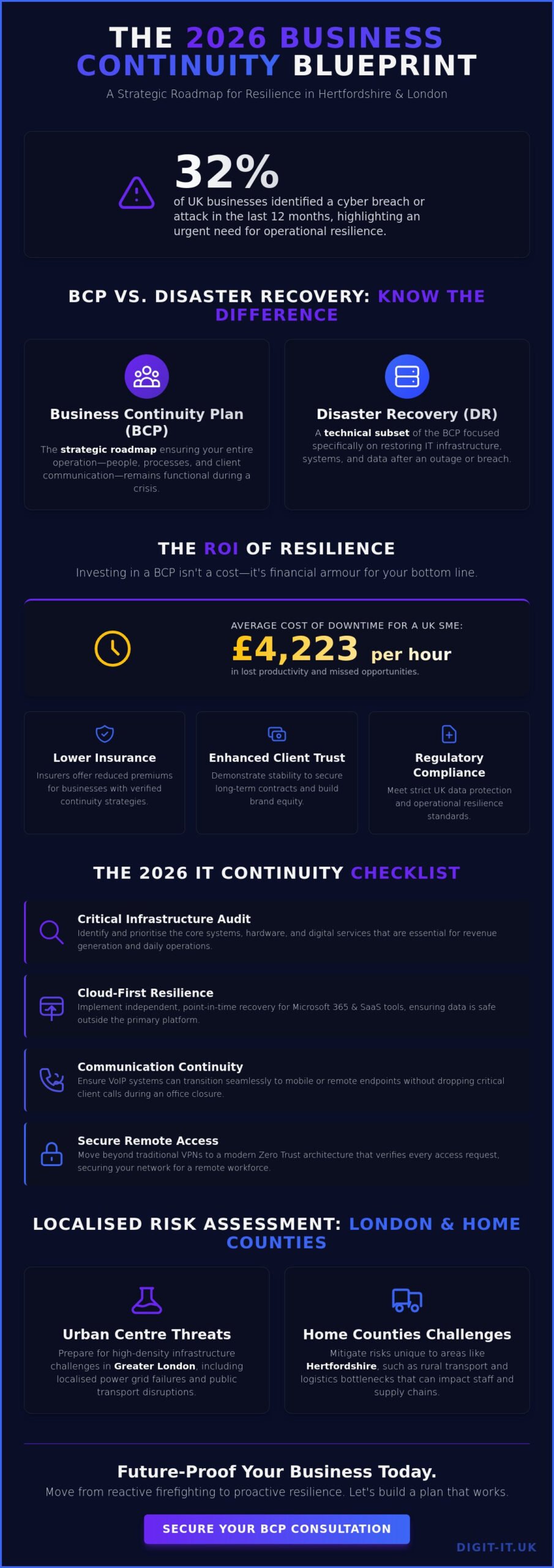
Recent data from the 2024 Cyber Security Breaches Survey reveals that 32% of UK businesses identified a breach or attack within the last 12 months. For an SME in Hertfordshire or London, the reality is that a digital disruption can cost more than just lost files; it can stall your entire operation. You’ve likely felt the anxiety of wondering if your current setup could survive a major hardware failure or a targeted cyber attack. While most owners recognise the importance of a business continuity plan, the distinction between simple data backups and true operational resilience often remains blurred.
We believe that technology should be your greatest advantage, not your biggest vulnerability. This guide provides a clear, actionable checklist to ensure your business remains functional through any crisis in 2026. We’ll move beyond theory to give you a strategic roadmap for minimising downtime and securing your stakeholders’ peace of mind. You’ll discover how to audit your managed infrastructure, automate recovery protocols, and future-proof your firm against the unique risks facing the Home Counties and Greater London.
Key Takeaways
- Discover how a robust business continuity plan secures your operations, distinguishing essential technical recovery from long-term strategic resilience.
- Audit your critical IT infrastructure and cloud data to ensure seamless access to Microsoft 365 and SaaS tools during a major service disruption.
- Evaluate localised risks specific to the Home Counties and Greater London, from high-density urban power failures to rural transport and logistics challenges.
- Build an actionable response framework by assembling a dedicated Crisis Management Team and documenting clear, multi-channel emergency communication trees.
- Future-proof your strategy by moving beyond static documentation with proactive testing and regular maintenance cycles that evolve alongside your business growth.
What is a Business Continuity Plan (BCP) for a Modern UK SME?
A business continuity plan is your strategic roadmap for maintaining critical operations when the unexpected hits. It’s far more than just a backup of your digital files. It’s a comprehensive framework that ensures your staff, internal processes, and technology remain functional during a crisis. For a Hertfordshire or London SME in 2026, this means preparing for everything from sophisticated ransomware attacks to localized power grid failures or transport disruptions that prevent your team from reaching the office.
Adopting a resilience first mindset shifts your focus from simply recovering after a crash to ensuring uninterrupted service. This proactive stance is essential because modern clients expect 24/7 availability. In the competitive landscape of the Home Counties, even an hour of silence can drive a long-term partner toward a more stable competitor. What is a Business Continuity Plan? At its core, it’s the difference between a temporary setback and a permanent business closure. It’s about building a company that’s tough enough to withstand the volatile economic and digital pressures of the mid-2020s.
BCP vs. Disaster Recovery: Knowing the Difference
Disaster Recovery (DR) is a technical subset of your broader plan. It focuses specifically on data restoration and getting your IT systems back online after a breach or hardware failure. While DR handles the bits and bytes, the business continuity plan serves as the human and process side of survival. It dictates how your team communicates, where they work if the physical office is inaccessible, and how manual workarounds function while systems reboot. Digit-IT integrates both elements into a seamless managed IT support London strategy. We ensure your technical recovery aligns perfectly with your operational needs, so your business doesn’t just survive; it thrives without skipping a beat.
The ROI of Resilience: Why Planning Saves Money
Downtime is expensive. Recent industry data indicates that for a UK SME with 50 employees, the cost of a total IT outage averages £4,223 per hour in lost productivity and missed opportunities. By 2026, increased reliance on real-time cloud data means this figure is only climbing. A robust plan acts as financial armor, protecting your bottom line from these sudden drains.
- Lower Insurance Premiums: Many UK insurers now offer reduced rates for businesses that demonstrate ISO 22301 compliance or have verified continuity strategies in place.
- Enhanced Client Trust: Showing your partners that you’ve accounted for the volatile landscape of 2026 builds immense brand equity and secures long-term contracts.
- Regulatory Compliance: With stricter UK data protection and operational resilience standards coming into force, having a formal plan is often a legal necessity for SMEs in the professional services sector.
Investing in a plan today prevents the chaotic, high-cost “firefighting” that occurs when a business is caught unprepared. It’s a calculated move that secures your future and gives you a distinct advantage over less prepared rivals in the London market.
The 2026 IT Continuity Checklist: Essential Technical Components
Your business continuity plan relies on a robust technical foundation. In 2026, London and Hertfordshire SMEs face a more complex threat landscape than ever before. We begin by conducting a critical infrastructure audit to identify the systems that must remain operational at all costs. This isn’t just about hardware; it’s about the digital services that drive your revenue. Identifying these potential bottlenecks allows us to prioritise resources where they matter most during a crisis.
Modern resilience requires a cloud-first strategy. While many firms use Microsoft 365 or SaaS tools, simple synchronisation isn’t a backup. You need independent, point-in-time recovery options that exist outside the primary platform. Communication continuity is equally vital. If your physical office closes due to local infrastructure failure, your VoIP systems must transition to mobile or remote endpoints without dropping a single client call. Secure remote access has also evolved. Traditional VPNs are often insufficient for the high-speed demands of 2026; modern standards demand a Zero Trust architecture to ensure that remote workers don’t become a backdoor for threats. For a Step-by-Step Implementation of these core strategies, looking at established frameworks helps ensure no detail is overlooked.
Data Backup and Recovery: The Backbone of Your Plan
Data is your most valuable asset. We implement the 3-2-1 backup rule but with a modern requirement: immutable cloud copies. This means your data cannot be altered or deleted by ransomware, providing a “gold standard” recovery point. You can find more detail on this in our guide to Data Backup and Recovery for SMEs. To ensure your business remains agile, we define clear Recovery Time Objectives (RTO) and Recovery Point Objectives (RPO). If a server fails at 10:00 AM, an RPO of 15 minutes ensures you only lose data created since 9:45 AM. It’s about precision and speed.
Cyber Security Integration
A modern business continuity plan must assume a total ransomware lockdown is a possibility. It’s no longer enough to react; you must be proactive. Our approach integrates continuity with the Cyber Security for Small Business UK framework. Proactive monitoring acts as your first line of defence, detecting anomalies before they escalate into a full-scale outage. By 2025, 60% of UK SMEs had reported a cyber incident, making this integration a commercial necessity rather than a luxury.
Localised Risk Assessment: Threats to Hertfordshire and London Businesses
Resilience isn’t a generic concept. A business continuity plan for a firm in Canary Wharf looks fundamentally different from one based in a rural Hertfordshire business park. London SMEs face unique pressures from high-density infrastructure. Grid congestion in boroughs like Southwark or Tower Hamlets can lead to localised power surges, while transport disruptions on the Elizabeth Line or the London Underground can instantly prevent 70% of your workforce from reaching the office. You need to plan for a scenario where your physical premises are inaccessible but your digital operations must remain live.
In contrast, Hertfordshire and Buckinghamshire firms often struggle with physical logistics and environmental factors. Rural roads are more susceptible to closures during extreme weather, and the 2024 floods showed how quickly local supply chains can fracture when key arterial routes are blocked. If your primary vendor is a local specialist who goes offline, your production could stall within 24 hours. Cyber-targeting also remains a critical threat. The 2023 UK Government Cyber Security Breaches Survey found that 32% of businesses identified an attack in the previous year. London-based SMEs are high-value targets because they often serve as “soft entry points” into larger global supply chains, making proactive defence a necessity rather than an option.
Identifying Your ‘Single Points of Failure’
A Business Impact Analysis (BIA) is the foundation of your strategy. It moves beyond generalities to identify which specific processes will cause the most financial and reputational damage if they stop for four hours, eight hours, or a full business day. You must also look at your human capital. Many SMEs rely on a single individual who holds the “keys to the kingdom,” whether that’s administrative passwords or unique technical knowledge. The ‘Bus Factor’ in business continuity planning is the minimum number of team members who can be hit by a bus before a project or business function comes to a complete standstill. Diversifying this knowledge is essential for long-term stability.
Hertfordshire and Buckinghamshire: Rural Connectivity Risks
Connectivity remains the Achilles’ heel for firms outside the M25. While London enjoys dense fibre coverage, rural business parks in areas like Tring or the Chilterns often suffer from broadband instability. A single digger hitting a cable can take your entire office offline for days. This is where 5G failover becomes a critical continuity tool. By deploying hardware that automatically switches to high-speed cellular data when a fixed line fails, you ensure your team stays connected to cloud resources without intervention. Digit-IT supports local firms with managed IT services that prioritise this level of redundancy. We don’t just fix problems; we build infrastructure that anticipates them, ensuring your rural location never becomes a strategic disadvantage.
Step-by-Step Implementation: Creating Your BCP Document
Building a resilient framework requires more than just a theoretical overview; it demands a structured, actionable document. In 2025, 82% of UK SMEs that successfully recovered from a major disruption had a documented, tested plan in place. Your business continuity plan serves as the operational manual that guides your team through the first 48 hours of any crisis, ensuring that panic is replaced by precise, rehearsed action.
- Step 1: Assemble your Crisis Management Team (CMT). Identify specific individuals to lead the response. You need an Incident Commander to make final decisions and a Communications Lead to handle all messaging. In a Hertfordshire SME, these roles often overlap, but the accountability must remain clear.
- Step 2: Document emergency contact trees. Speed is the priority when a server fails or an office becomes inaccessible. Create a hierarchical notification list for staff, London-based clients, and critical vendors. Ensure this list includes personal mobile numbers and secondary email addresses.
- Step 3: Define ‘Trigger Points’ for activation. Not every IT glitch requires a full-scale response. Set specific thresholds, such as a 4-hour total system outage or a confirmed data breach, to officially trigger the plan. This prevents overreaction while ensuring a 100% response rate for genuine threats.
- Step 4: Establish secure, off-site access. If your local network is compromised, your digital BCP document must be hosted elsewhere. Store encrypted copies in a secure cloud environment and keep one physical, offline version in a fireproof safe.
The Communication Plan: Keeping Stakeholders Informed
Reputation management depends on how quickly you speak to your clients. Draft pre-approved message templates for system outages or service delays before an incident occurs. This allows your team to hit ‘send’ within 30 minutes of a trigger point. Use VoIP and unified communications to ensure your London or Hertfordshire landline numbers can be answered from any remote location. This maintains a professional front and reassures clients that your business remains operational. For internal updates, use a dedicated messaging app that operates independently of your primary email server to keep the team aligned without delay.
Hardware and Asset Management
Your team’s ability to work from home depends on the security of their kit. Every laptop used for remote recovery must meet the same security standards as your office workstations. This includes knowing how to wipe a laptop securely if a device is lost or stolen during a chaotic transition. Maintain an up-to-date inventory of all IT assets, including serial numbers and purchase dates. This list is vital for insurance claims; UK providers often require this level of detail to process payouts for hardware replacement within their standard 30-day window.
Reliability is built through preparation, not luck. To ensure your infrastructure is ready for any challenge, explore our strategic continuity services and let us help you bridge the gap between risk and resilience.
Testing and Maintenance: Ensuring Your Plan Actually Works
Most SMEs treat their business continuity plan as a “one and done” task. This creates “shelfware,” a document that looks impressive in a folder but crumbles during a live incident. According to the 2024 BCI Horizon Scan Report, 35% of business disruptions are caused by cyberattacks, yet many plans remain unverified for over 12 months. A static document cannot protect a dynamic business. You must schedule review cycles at least every six months to account for software updates, staff turnover, and new hardware acquisitions.
The human element is often the weakest link in any recovery strategy. Technology is only half the battle; your staff must understand their specific roles without searching for a manual during a crisis. Regular training sessions ensure that “muscle memory” kicks in when pressure is high. If your team doesn’t know who has the authority to trigger a failover, your recovery time objectives will likely be missed.
Running a Successful Tabletop Exercise
A tabletop exercise is a low-stakes simulation where key stakeholders discuss their response to a hypothetical disaster. It’s about testing logic and communication rather than just technical buttons. Consider these two scenarios for your next session:
- The Monday Morning Ransomware Attack: A staff member clicks a malicious link, and by 9:00 AM, a £25,000 ransom demand appears on every screen. Who is the first person called?
- The Office Flood: A burst pipe in a shared London workspace destroys local servers and renders the site inaccessible. How quickly can your team pivot to remote work?
Once the drill concludes, evaluate the performance. Did the communication tree work? Was the contact list for third-party vendors accurate? Identifying these gaps in a boardroom prevents a total collapse when a real disaster strikes.
Digit-IT as Your Continuity Partner
At Digit-IT, we believe the best business continuity plan is one that rarely needs to be triggered. Our 24/7 monitoring identifies 90% of potential system failures before they impact your operations. We act as a strategic extension of your team, moving your infrastructure from reactive “fixing” to proactive resilience. We ensure your backups are not just running, but are actually recoverable through regular automated testing.
We provide the calm authority needed to navigate the complex threat landscape of 2026. By future-proofing your systems today, we provide the peace of mind that allows you to focus on growth rather than disaster recovery. Our partnership model ensures that as your business evolves, your protection evolves with it.
Ready to secure your future? Book your Free IT Health Check to start your continuity journey today.
Future-Proof Your SME Against the Unexpected
Building a resilient business in 2026 requires more than reactive fixes. It demands a robust business continuity plan that integrates 24/7 proactive monitoring with a deep understanding of the London and Hertfordshire risk landscape. You’ve seen how technical checklists and localised threat assessments form the backbone of a secure operation. Success doesn’t happen by accident; it’s the result of rigorous testing and a Cyber Essentials focused approach that protects your commercial reputation.
At Digit-IT, we bring over 20 years of experience to your doorstep, acting as a strategic extension of your internal team. We don’t just manage infrastructure; we deliver the peace of mind that comes from knowing your digital assets are shielded around the clock. By aligning your technical recovery steps with clear business objectives, you’ll ensure your SME remains agile and operational regardless of what the future holds.
Secure your business future with Digit-IT’s expert continuity planning
The road to resilience is a partnership, and we’re ready to help you navigate it with confidence.
Frequently Asked Questions
What are the 4 stages of a business continuity plan?
A standard business continuity plan consists of four critical stages: Mitigation, Preparedness, Response, and Recovery. Mitigation focuses on identifying and reducing risks before they occur, while Preparedness involves building the actual plan and training your team. The Response phase outlines the immediate actions taken during a crisis, and Recovery details how you’ll return to normal operations. Following this structured approach ensures your Hertfordshire SME remains resilient against unexpected disruptions.
How often should a small business in London update its BCP?
You should review and update your plan at least once every 12 months or immediately following any major operational shift. In the fast-paced London market, 35 percent of SMEs fail to update their documentation after moving offices or adopting new software. Regular testing ensures your strategies remain effective as your technology and staff evolve. Don’t leave your recovery to chance; perform a full audit after any significant infrastructure change to maintain total coverage.
Is a business continuity plan a legal requirement for UK companies?
While not a universal legal requirement for every UK SME, the Civil Contingencies Act 2004 mandates continuity planning for Category 1 responders like the NHS and local councils. However, if you operate in regulated sectors like finance, the Financial Conduct Authority (FCA) requires robust resilience strategies. Beyond legalities, most modern supply chain contracts now demand proof of a business continuity plan before you can secure high-value partnerships with larger corporations.
What is the difference between RTO and RPO in a continuity plan?
Recovery Time Objective (RTO) measures how quickly you need your systems back online, while Recovery Point Objective (RPO) defines the maximum amount of data loss your business can tolerate. If your RTO is 4 hours, your team must be operational within that window. An RPO of 1 hour means you’ll lose no more than 60 minutes of work. Balancing these two metrics is essential to optimise your disaster recovery budget and meet client expectations.
Can a business continuity plan protect us from a cyber attack?
A BCP doesn’t prevent a cyber attack, but it dictates exactly how your business survives the aftermath. While Cyber Essentials provides the perimeter defence, your continuity strategy ensures you can restore systems from clean backups if ransomware hits. In 2023, 32 percent of UK businesses reported a breach. Having a clear roadmap reduces panic and ensures your technical team can isolate threats without halting every department or losing vital customer data.
What should be included in a BCP emergency contact list?
Your emergency contact list must include 24/7 details for all staff, key technology vendors, insurance brokers, and local emergency services. You should also include your primary clients and utility providers. Store this list in a secure, offline format so it’s accessible if your main servers go dark. Don’t forget to include clear escalation paths. This ensures the right decision-makers are notified within the first 15 minutes of an incident occurring.
How much does it cost to implement a business continuity plan for an SME?
Implementation costs vary based on your infrastructure complexity, but UK industry benchmarks suggest SMEs typically allocate 2 percent to 5 percent of their total IT budget toward resilience. For a small firm, this might involve initial consultancy fees and monthly subscriptions for automated backup tools. Investing in a proactive strategy is significantly cheaper than the £4,220 average cost per day of downtime reported by many London businesses during technical failures.
Do we need a BCP if all our files are on Microsoft 365?
Yes, because Microsoft 365 operates on a shared responsibility model where you remain responsible for your own data and user errors. While Microsoft ensures the platform stays active, they don’t protect you against accidental deletion, internal threats, or configuration errors. A bespoke business continuity plan fills these gaps. It provides third-party backups and a strategy for when your internet connection or local hardware fails, ensuring your London team stays productive.

