


The 2027 PSTN switch-off isn’t just a technical update; it’s a mandatory evolution that will silence any London or Hertfordshire firm caught unprepared. You’ve likely heard the warnings and felt the pressure to modernise, but the fear of losing your established 020 or 01923 area code or suffering through jittery digital calls is keeping you hesitant. It’s a valid concern when your professional reputation relies on every conversation being perfect and uninterrupted.
We’re here to ensure your transition to a digital business phone service is a strategic advantage rather than a technical headache. You’ll discover how to navigate the upcoming landline shutdown with absolute confidence, maintaining your local presence while upgrading to a system that offers superior clarity and resilience. We will guide you through the process of future-proofing your communications, from understanding cloud-based managed infrastructure to choosing a partner who provides proactive, localised support. This guide provides a clear roadmap to ensure your business remains connected, professional, and ready for the digital-only era.
Key Takeaways
- Understand the critical timeline for the 2027 PSTN switch-off and why delaying your transition could disrupt your business operations.
- Discover how a modern business phone service reduces overheads on international calls while enabling seamless hybrid working across London and Hertfordshire.
- Learn how to evaluate uptime guarantees and ensure your business retains its essential local identity through 020, 01923, and 01296 area code porting.
- Follow a structured five-step migration plan to audit your connectivity and choose the right hardware for a future-proofed communication strategy.
- Explore the strategic advantages of partnering with a local managed telephony expert to align your communications with your broader digital infrastructure.
The 2027 UK Landline Shutdown: Why Your Business Phone Service Must Change
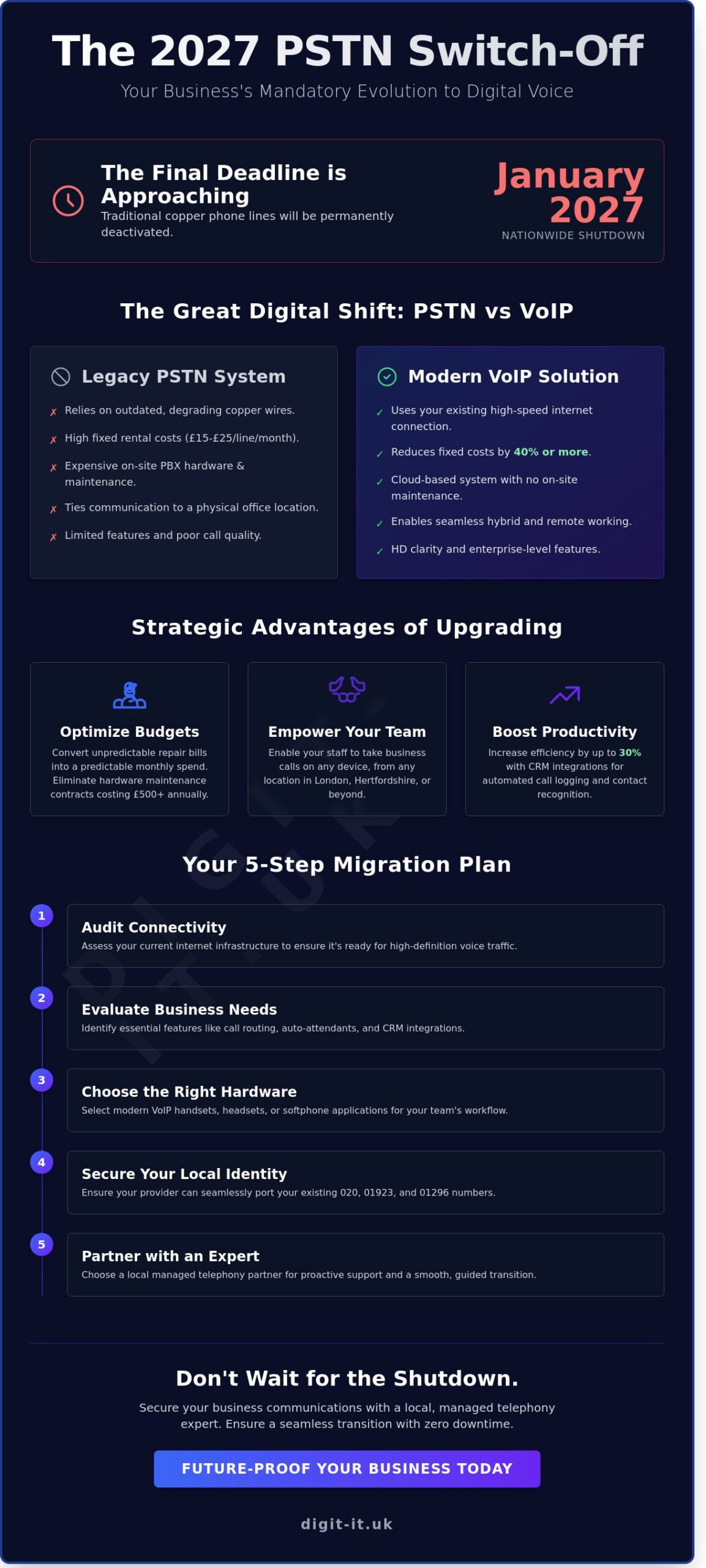
The UK’s communication landscape is facing a hard deadline. By the end of January 2027, the traditional Public Switched Telephone Network (PSTN) will be deactivated across the entire country. This means the copper-based infrastructure that has supported London businesses for decades is being permanently retired by Openreach. If your organisation still relies on ISDN or analogue lines, your business phone service will stop working when the switch-off concludes. Openreach implemented a national “stop-sell” on legacy products in September 2023, effectively ending the era of analogue telephony and forcing a shift toward digital-first solutions.
What is the “Big Switch-Off”?
The Big Switch-Off is the transition from old-fashioned analogue voice technology to a fully digital, internet-based network. Every business in Greater London and the surrounding counties must migrate to avoid a total loss of connectivity. Migration timelines in Hertfordshire and Buckinghamshire are already accelerating as local exchanges move to “fibre-first” status. Leaving this transition until the final months of 2026 creates unnecessary operational risks. You face potential hardware shortages and a lack of available installation engineers as thousands of companies scramble to meet the deadline. A proactive approach ensures your resilience and prevents the panic of a forced, last-minute setup.
VoIP: The Modern Standard for SMEs
The successor to the legacy network is a technology that leverages your existing internet connection to facilitate high-definition voice calls. Voice over Internet Protocol (VoIP) is a digital communication tool that replaces traditional copper lines. This technology breaks voice signals into digital packets, sending them over the same fibre lines used for your office broadband. It’s a more efficient way to manage your business phone service, as it eliminates the need for separate physical phone lines and expensive on-site hardware maintenance.
Integrating your telephony into your wider managed services creates a unified environment where staff can take calls from any location. This flexibility isn’t just a technical upgrade; it’s a requirement for modern SMEs looking to optimise their operations and maintain a competitive edge. Digital lines offer superior clarity and security, ensuring your client communications remain professional and uninterrupted. By making the switch now, you position your business as a forward-thinking entity that’s ready for the digital future of the UK’s capital.
Key Benefits of Modern Business VoIP Solutions
Transitioning to a cloud-based business phone service is a strategic move for long-term resilience. The 2027 UK Landline Shutdown represents a critical deadline for every organisation in London and Hertfordshire. Moving to Digital Voice ensures your communication remains uninterrupted while providing a proactive way to manage costs. This shift removes the burden of maintaining legacy copper wires and positions your firm as a forward-thinking player in a digital-first economy.
Modern systems offer a suite of professional features that were once only available to large enterprises. Auto-attendants ensure every caller reaches the right department without delay, while voicemail-to-email ensures no lead is missed during busy periods. These tools create a polished image for your brand, regardless of your headcount. By integrating your business phone service with Microsoft 365 or your chosen CRM, you can boost productivity by up to 30% through automated call logging and instant contact recognition.
Reducing Costs and Optimising Budgets
Traditional ISDN lines often cost between £15 and £25 per month for rental alone. Switching to a per-user VoIP model typically reduces these fixed costs by 40% or more. You can eliminate expensive maintenance contracts for physical PBX hardware, which often cost small businesses upwards of £500 annually. This transition converts unpredictable repair bills into a predictable monthly IT spend, allowing for more accurate financial forecasting. Our team can help you optimise your managed infrastructure to ensure these savings are maximised across your entire estate.
Empowering the Mobile Workforce
London-based teams require the flexibility to work from the office, from home, or while commuting across the Home Counties. Mobile apps allow staff to carry their office extension on their personal devices, maintaining a professional front at all times. Presence features provide a real-time view of team availability, showing who is on a call or away from their desk. This visibility is vital for maintaining a cohesive culture in hybrid environments. It ensures that customer behaviour remains consistent; your clients receive the same high level of service whether your staff are in a Mayfair boardroom or a home office in St Albans.
- Scalability: Add or remove users instantly as your team grows or during seasonal peaks.
- Security: Benefit from enterprise-grade encryption and proactive monitoring to prevent toll fraud.
- Business Continuity: Automatically reroute calls to mobile devices or secondary locations if your primary office loses power.
Choosing the Right Provider: Features vs. Reliability
Selecting a professional business phone service shouldn’t be a gamble on call quality. While consumer-grade VoIP apps offer low entry costs, they often lack the Service Level Agreements (SLAs) that guarantee 99.99% uptime. For a firm in Watford or St Albans, a dropped call isn’t just an inconvenience; it’s a lost contract. Professional providers offer dedicated bandwidth for voice traffic, ensuring that high data usage in the office doesn’t degrade audio clarity. Small UK firms lose an average of £12,000 per hour during communications downtime, making a robust SLA your most important insurance policy.
Local identity remains a powerful tool for conversion. Retaining your 020, 01923, or 01296 area codes ensures you maintain a physical presence in the minds of London and Hertfordshire clients. Research indicates that 73% of consumers prefer dealing with local businesses, and a virtual landline allows you to project that stability even if your team is working remotely. Cheap consumer alternatives often force you into non-geographic 0330 numbers, which can feel impersonal and detached from your local community.
Essential Features for Professional SMEs
Professional SMEs require more than a simple dial tone to stay competitive. Essential tools like call recording and hunt groups ensure that every interaction is documented and every enquiry is answered. Hunt groups distribute incoming calls across multiple handsets, which helps eliminate the 25% of business calls that typically go unanswered in smaller offices. You can also use virtual landlines to establish a prestige London presence while your physical operations remain in Hertfordshire. These communication tools work best when they’re fully integrated into your wider Managed IT Support infrastructure, ensuring your hardware and software are always in sync.
The Security of Your Voice Data
Your phone system is a frequent target for cyber criminals. Toll fraud, where hackers hijack your lines to make high-cost international calls, costs UK businesses over £1.2 billion annually. A single breach can result in a bill exceeding £15,000 over a single weekend if your provider doesn’t have proactive monitoring in place. Managed providers protect your business by implementing end-to-end encryption and anti-fraud measures that automatically block suspicious dialling patterns. Securing your voice data is just as critical as protecting your email. You can find more detailed strategies in our guide to Cyber Security for Small Business UK, which outlines how to defend every entry point of your digital estate.
How to Migrate to a New Business Phone Service: A 5-Step Plan
Transitioning to a modern business phone service shouldn’t disrupt your daily operations. At Digit-IT, we view migration as a strategic upgrade rather than a simple hardware swap. With the UK’s PSTN switch-off scheduled for completion by December 2025, every business in London and Hertfordshire must adopt a digital-first approach to remain reachable. Our five-step plan ensures your communication remains resilient throughout the changeover.
Connectivity Check: Is Your Office Ready?
A stable internet connection is the foundation of any VoIP system. In Hertfordshire, where connectivity speeds vary between urban hubs like Watford and more rural areas, a bandwidth audit is essential. You’ll need roughly 100kbps of dedicated upload and download speed for every concurrent high-definition call. To prevent voice data from lagging behind standard web traffic, we implement “Quality of Service” (QoS) settings on your router. This prioritises voice packets, ensuring crystal-clear audio even during peak data usage periods.
Step two involves selecting your interface. Recent 2024 workplace data indicates that 62% of London-based professionals now prefer softphones or mobile apps over traditional desk units. We help you balance these needs, perhaps providing physical handsets for reception teams while equipping remote staff with integrated laptop software. This flexibility reduces upfront capital expenditure and supports a truly hybrid workforce.
The Number Porting Process
Retaining your established 020 or 01707 numbers is vital for brand consistency. The UK porting process typically takes 10 to 14 working days, provided your documentation is precise. A common pitfall is submitting a Letter of Authority (LoA) with details that don’t exactly match your current provider’s records. Even a minor address discrepancy can trigger a rejection. We manage this correspondence on your behalf to ensure a seamless “like-for-like” transfer without any downtime for your inbound callers.
Once the numbers are secured, we move to step four: configuring your call flow. This is your opportunity to optimise the customer journey. We help you design automated greetings and “hunt groups” that route calls to the right department instantly. A well-structured IVR (Interactive Voice Response) can reduce misdirected calls by up to 40%, significantly improving your team’s efficiency.
The final step is staff training and go-live testing. We don’t just flip a switch; we conduct thorough “floor-walking” and test every scenario, from voicemail-to-email delivery to emergency call routing. This proactive approach alleviates the anxiety of technical failure and ensures your team feels confident using their new tools from day one. If you’d like a deeper understanding of the technology underpinning this process, our essential VoIP guide for London and Hertfordshire businesses covers everything from hardware requirements to uptime guarantees in plain language.
Ready to modernise your infrastructure with a partner who understands the local landscape? Explore our comprehensive managed IT and communication services to start your migration today.
The Digit-IT Advantage: Managed Telephony in the South East
Choosing a business phone service shouldn’t feel like a gamble with a distant, faceless call centre. In the fast-paced markets of London and Hertfordshire, communication delays translate directly into lost revenue. While national providers often rely on rigid, tiered ticketing systems that leave your office silent for hours, our engineers are typically within a 45-minute drive of your premises. This local presence allows us to move beyond basic troubleshooting. We provide a bespoke setup that aligns with your specific physical infrastructure and your team’s hybrid workflows.
We don’t just ship handsets and send a digital manual. Our approach involves a deep dive into your current connectivity to ensure your voice traffic never competes with high-bandwidth data tasks. By optimising your local area network (LAN) and implementing Quality of Service (QoS) protocols, we guarantee that every call remains crystal clear, even during peak operational hours. This technical precision ensures your 24/7 call availability isn’t just a promise; it’s a monitored reality.
A Strategic Partnership, Not Just a Supplier
Digit-IT functions as your outsourced communications department. We believe that telephony is a pillar of your broader digital resilience, not an isolated utility. When you consolidate your communications and data under one roof, you eliminate the “finger-pointing” that often occurs between separate IT and phone vendors. You gain a single point of contact for every technical query, from a handset configuration to a complex server migration. This holistic view is a core component of our Managed IT Support London, where we treat your phone system as a vital asset within your IT ecosystem.
- Direct Accountability: One team manages the desk, the dial tone, and the data security.
- Bespoke Workflows: We tailor call routing and IVR menus to match how your specific team actually works.
- Proactive Resilience: We monitor your system performance in real-time to intercept potential failures before they impact your clients.
Future-Proofing Your Business Communication
Scalability is a non-negotiable requirement for businesses in the South East. A system that serves ten staff members in a St Albans office today must be capable of supporting 50 users across multiple locations by next year. We design your business phone service with this trajectory in mind, using cloud-native platforms that expand with a simple software update rather than a costly hardware overhaul. Our ongoing support includes regular system optimisations to ensure you’re always utilising the latest features, from AI-driven transcription to seamless CRM integrations. With 20 years of technical experience, we provide the peace of mind that comes from knowing your infrastructure is managed by veterans who understand the evolution of business technology. We don’t just solve today’s problems; we anticipate the demands of your business in 2026 and beyond.
Secure Your Connectivity Ahead of the 2027 Deadline
The 2027 UK landline shutdown is a fixed deadline that demands immediate strategic action from every local firm. Migrating to a modern business phone service isn’t just about avoiding a service gap; it’s an opportunity to build a more resilient, scalable infrastructure. By following a structured five-step migration plan, you can eliminate the risks of downtime and ensure your team stays connected from any location. High-quality VoIP solutions offer the clarity and flexibility that traditional copper lines lack.
Digit-IT provides the technical calm and authority you need during this transition. With over 20 years of IT expertise, we deliver dedicated local support across Hertfordshire, London, and Buckinghamshire. Our 24/7 proactive system monitoring identifies potential issues before they impact your operations, giving you total peace of mind. We act as your strategic partner, bridging the gap between complex digital tools and your specific commercial goals. You deserve a communication system that works as hard as you do.
Optimise your business communications today with Digit-IT
Let’s work together to future-proof your organisation and turn technical change into a distinct competitive advantage.
Frequently Asked Questions
What happens to my business phone number during the 2027 switch-off?
You can retain your existing business phone number by migrating it to a digital cloud-hosted platform before the January 2027 PSTN switch-off. This process, known as porting, ensures your brand identity remains intact while you transition to a more resilient infrastructure. We recommend starting this transition at least six months before the deadline to avoid the expected bottleneck as 2.4 million UK businesses move away from analogue lines.
Can I use my existing internet for a business VoIP service?
You can use your existing internet connection for a business phone service, provided you have sufficient bandwidth and a stable connection. Each concurrent high-definition voice call typically requires 100kbps of bandwidth. For a London office with 15 staff members, a standard fibre connection usually provides more than enough capacity to maintain crystal-clear audio quality without disrupting your other digital operations.
Do I need to buy new hardware for a digital phone system?
You don’t need to purchase new physical handsets because digital systems operate seamlessly via softphone applications on your existing laptops or smartphones. Many firms in Hertfordshire now choose this hardware-free approach to reduce capital expenditure. If you prefer traditional desk phones, you can either buy IP-enabled handsets or use ATA adaptors to connect 80% of older analogue models to your new digital network.
Is a VoIP phone service as reliable as a traditional landline?
A modern VoIP system is frequently more reliable than a traditional landline because it offers built-in redundancy and 99.999% uptime guarantees. Unlike physical copper wires that are vulnerable to local exchange faults or weather damage, cloud-based systems can instantly reroute calls to mobile devices if your office loses power. This proactive approach to business continuity ensures you never miss a critical client enquiry during a local network outage.
How much does a professional business phone service cost in the UK?
A professional business phone service in the UK generally costs between £10 and £35 per user per month, depending on the features you require. Entry-level packages often include basic call handling, while premium tiers provide advanced integrations with CRM software and call recording. These fixed monthly costs help you manage your budget effectively, as they typically include all UK landline and mobile calls within the subscription price.
Can I use my business phone service while working from home?
You can use your business phone service from any location with an internet connection, making it the ideal solution for hybrid teams in London and Hertfordshire. By using a dedicated mobile app, your smartphone acts as a full office extension, displaying your professional business number rather than your personal one. This flexibility ensures your team remains productive and reachable whether they’re at their desk, at home, or visiting a client site.
What is the difference between a virtual landline and VoIP?
A virtual landline is a simple forwarding service that directs calls to another number, whereas VoIP is a comprehensive communication platform. While a virtual number helps you establish a local presence in a specific area code, a VoIP system provides 50 or more advanced features like internal transfers, automated attendants, and video conferencing. VoIP acts as a strategic tool to optimise your entire team’s workflow rather than just a basic call redirection.
How long does it take to set up a new business phone service?
You can set up a new digital phone system in as little as 24 hours if you’re using new numbers and software-based phones. If you need to port your existing business numbers from an old provider, the process typically takes between 7 and 14 working days to complete. Our team manages this timeline carefully to ensure a seamless transition, preventing any downtime or disruption to your daily business operations.


1 Comment
Best Business VoIP Providers in London: The 2026 SME Buying Guide - Digit-IT
[…] daily operations. For businesses seeking comprehensive guidance through this process, our detailed business phone service selection guide provides step-by-step support for London and Hertfordshire […]